AP Road Trip: Racial Tensions In America's Sun Down Towns. Click here.


14 Oct 2020

VIENNA, Ill. (AP) — Ask around this time-battered Midwestern town, with its empty storefronts, dusty antique shops and businesses that have migrated toward the interstate, and nearly everyone will tell you that Black and white residents get along really well.

“Race isn’t a big problem around here,” said Bill Stevens, a white retired prison guard with a gentle smile, drinking beer with friends on a summer afternoon. “Never has been, really.”

“We don’t have any trouble with racism,” said a twice-widowed woman, also white, with a meticulously-kept yard and a white picket fence.

But in Vienna, as in hundreds of mostly white towns with similar histories across America, much is left unspoken. Around here, almost no one talks openly about the violence that drove out Black residents nearly 70 years ago, or even whispers the name these places were given: “sundown towns.”

Unless they’re among the handful of Black residents.

“It’s real strange and weird out here sometimes,” said Nicholas Lewis, a stay-at-home father. “Every time I walk around, eyes are on me.”

___

The rules of a sundown town were simple: Black people were allowed to pass through during the day or go in to shop or work, but they had to be gone by nightfall. Anyone breaking the rules could risk arrest, a beating or worse.

These towns were an open secret of racial segregation that spilled over much of the nation for at least a century, and still exist in various forms, enforced today more by tradition and fear than by rules.

Across America, some of these towns are now openly wrestling with their histories, publicly acknowledging now-abandoned racist laws or holding racial justice protests. Some old sundown towns are now integrated. But many also still have tiny Black communities living alongside residents who don’t bother hiding their cold stares of disapproval.

___

This story was produced with the support of the Pulitzer Center on Crisis Reporting.

___

Mailboxes line a street in Jonesboro, Ill., on Sunday, Aug. 2, 2020. (AP Photo/Wong Maye-E)
Milton L. McDaniel, Sr., attends a service at Boskydell Baptist Church in Carbondale, Ill. (AP Photo/Wong Maye-E)
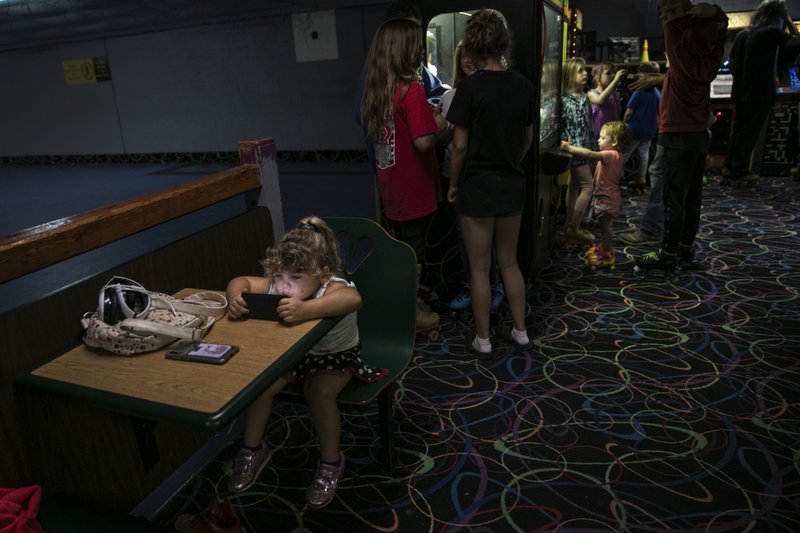
A girl is immersed in a smartphone game while others play in an arcade at a skating rink in Anna, Ill. (AP Photo/Wong Maye-E)

This part of southern Illinois had at least a half-dozen sundown towns. We came here on the second stop of The Associated Press’ road trip across America, a reporting journey that three of us are taking to look at how the U.S. has been shaken and shaped by months of protests, the COVID-19 pandemic, an economic crisis and the looming November elections.

We wanted to take a close look at systemic racism, trying to understand how something that is so crushingly obvious to some people can be utterly invisible to others.

So we went to a longtime sundown town.

They were called “grey towns,” in some parts of America, “sunset towns” in others. The terms were used by both Black and white people.

Very often, especially in well-to-do suburbs that didn’t want to be known as racist, they had no name at all. But they still kept out Black residents. There were hundreds of such towns, scholars say, reaching from New York to Oregon. Perhaps thousands.

James Loewen, a historian who spent years studying sundown towns, found them in the suburbs of Detroit, New York City and Chicago. He found them outside Los Angeles, in midwestern farming villages and in New England summer towns.
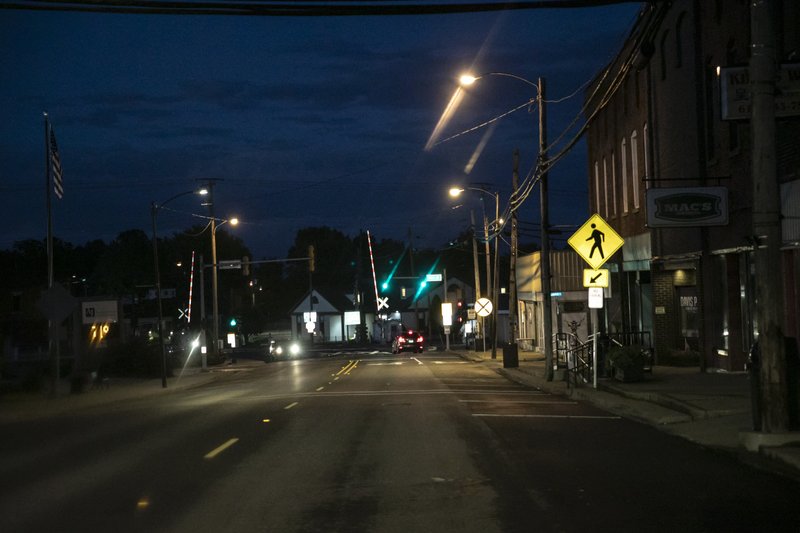
Dusk settles over Anna, Ill. (AP Photo/Wong Maye-E)

Sometimes, the rules were official policies, with signs at the edge of towns warning Black people to be gone by nightfall. More often, everyone - both Black and white - simply knew the unwritten rules.

In this area, near the borders of both Missouri and Kentucky, young Black people were raised to be aware of which towns they should avoid.

“It was something that was known,” said James Davis, 27, a Black truck driver from the nearby town of Cairo, which is largely Black. “But also something that our parents taught us growing up.”

In places still seen as sundown towns, many Black people now follow their own rules: Avoid them if possible, and lock your car doors if you have to drive through. If you stop for gas, look for a well-lit gas station with security cameras.

So it is in Vienna.

“Every time you come into town, or you go into a gas station, or in a store, people look at you,” said Victoria Vaughn, a biracial 17-year-old who has been coming to Vienna for years to visit her white grandparents.


“You can feel them looking at you, feel them staring,” she said. “I’ve never had anybody say anything (racist) to me in Vienna, but I’ve definitely felt the way they felt about me.”

She was in Vienna on a recent Saturday to join a rally organized after a group of Vienna High School students created a social media account that included the phrase “hate Black people” in its title. Vaughn and her grandmother were among the 50 or so people who turned out for the rally, along with about 25 counter-protesters.

At first things went well. Protesters and counter-protesters prayed together. They talked calmly about race. But not for long.

“Bullshit!” an older white man shouted at Vaughn, after she said Black people aren’t treated equally. “They get the same as the white people get!”

Vaughn, whose grandmother gently pulled her back from the confrontation with the angry older man, isn’t surprised that Vienna’s white residents don’t see racial issues around them. The situation is far more subtle today than when Black residents were forced out.

“Until you live in a Black or brown person’s body you’re not going to understand,” she said. “You have to know somebody who lived it, or live it yourself, to truly understand.”

___

Today it’s just an overgrown field, vibrant green from recent rains.

But 60 years ago, there was a small collection of houses along that stretch of 7th Street, where the outer edges of Vienna bump up against Little Cache Creek. Everyone who lived there was Black.
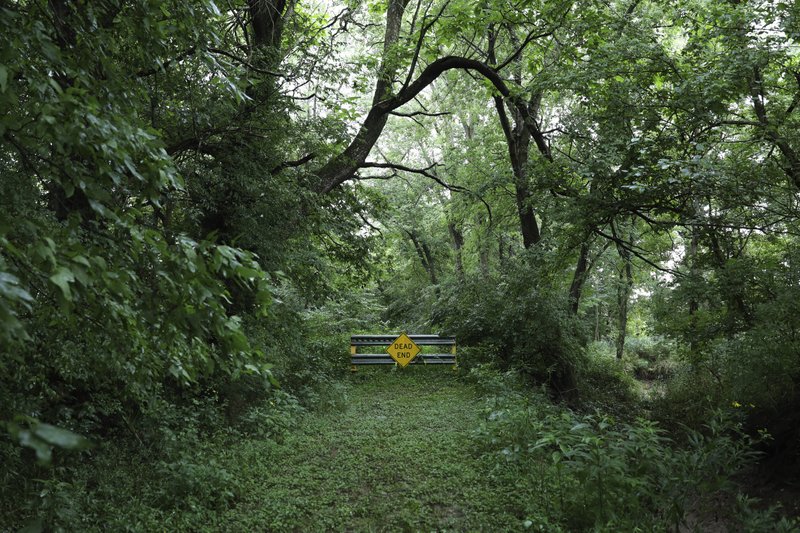
A "Dead End" sign is posted on the far end of 7th Street in Vienna, Ill. There was a small collection of houses along 7th Street, near where the outer edges of Vienna bumps up against Little Cache Creek. (AP Photo/Wong Maye-E)

The violence erupted in August, 1954, after the arrest of a 31-year-old resident, Thomas Lee Latham, who was accused of brutally beating an elderly white woman with a soft drink bottle and trying to rape her granddaughter.

"Vienna Negro Held on Charge of Assault With Attempt to Murder,” the Vienna Times declared on its front page after Latham was arrested, hours after the attack. The older woman died days later.

A few weeks after his arrest, Latham escaped from jail. Dozens of armed men took to the streets of Vienna and the surrounding fields, backed up by bloodhounds and spotters in low-flying planes.

Within hours, the cluster of Black homes along 7th Street were ablaze, with smoke and flames rising above the town.

A week or so later Latham gave himself up and pleaded guilty. One day after he surrendered, he was sentenced to 180 years in prison.

By then, the town’s Black residents were gone.

"The Black community, from that point on, disappeared from Vienna,” said Darrel Dexter, a historian and high school teacher who has studied the violence of 1954.

Black people had lived in and around Vienna since the late 1820s or early 1830s, said Dexter. But he estimates that after the fires, perhaps 50 people fled the town. The town later repaid Black residents for their lost homes, the Times reported, though there is no indication anyone was ever prosecuted.

The 1950 census showed 54 Black people living in Vienna.

In 2000, it showed one.

___

A couple of blocks from the field where Vienna’s Black community once lived, down a narrow dead-end street, a grandmother with pink fingernails and an easy laugh watches over an extended family that spans much of America’s Black-white divide.

They are not what you’d expect to find here.

“It’s our sanctuary,” Maribeth Harris said of the street. One of her daughters lives next door. Another lives across the street with her boyfriend, Nicholas Lewis. Harris has custody of three grandkids while Lewis cares for the fourth, an 18-month-old in Spiderman pajamas on a recent afternoon.

Harris, her husband and their daughters are white. Lewis is Black. The grandchildren are biracial.

“This is our own little world down here,” Harris said, sighing before she begins listing some of the troubles the family has faced. “They just brush everything under the rug.”
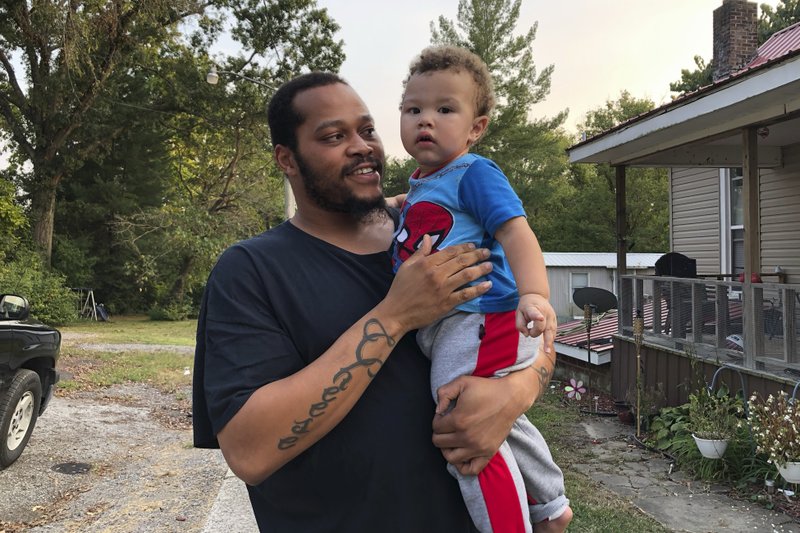
Nicholas Lewis holds son, Nick Jr., near their home in Vienna, Ill. (AP Photo/Noreen Nasir)

There was the time one of the kids was called “burned toast” by a classmate. Or when an elderly woman walked past the family at a church dinner and loudly called the children “damn half-breeds.”

There was the day the 10-year-old came home with a painful question: “Grandma, why do I have to be Black?”

She and her husband moved to Vienna about 10 years ago from northern Illinois, chasing work and a cheaper cost of living. But with her oldest grandson edging up on adolescence, she knows they should leave soon, before they have to worry about such things as confrontations with police.

“We want to get out of here,” she said. “We have to figure out what’s good for them. And Vienna won’t be good for them.”

Lewis joined the little enclave two years ago, expecting a short visit but staying after his girlfriend, one of Harris’ daughters, got pregnant.

He’s an unassuming man deeply in love with his young son, Nick. If he hasn’t felt the sting of outright racism in Vienna, he’s exhausted by how residents constantly watch him.

It’s complicated, he added, because most people are friendly once they know him. But he also believes his family should leave.

“I don’t want my son raised down here,” he said. “I don’t want him out here where (white people) are all he sees.”

___
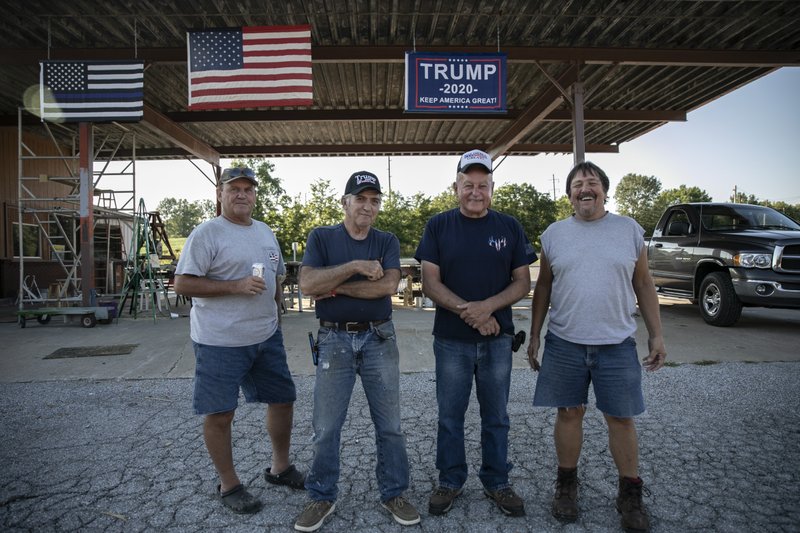
Trump supporters Jim Rainbolt, 57, left, Rick Warren, 65, Bill Stevens, 76, and Roger Plott, 65, stand outside their clubhouse in West Vienna, Ill. (AP Photo/Wong Maye-E)
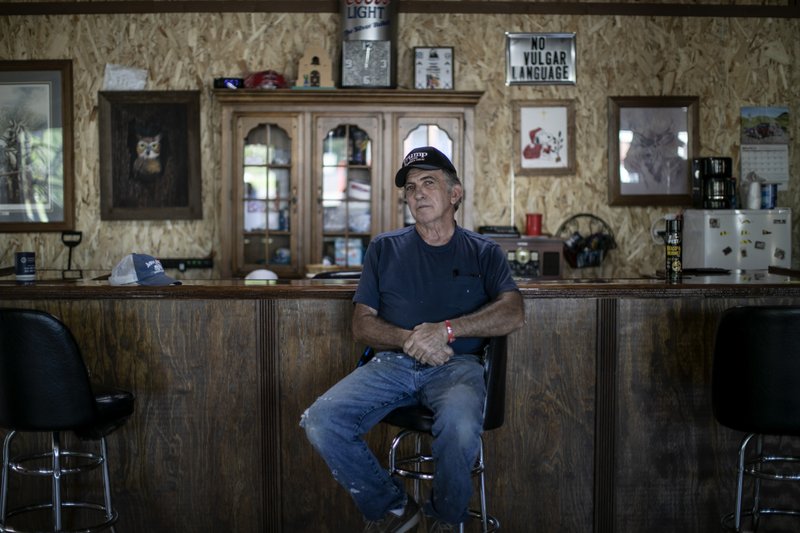
Rick Warren 65, poses for a portrait. (AP Photo/Wong Maye-E)
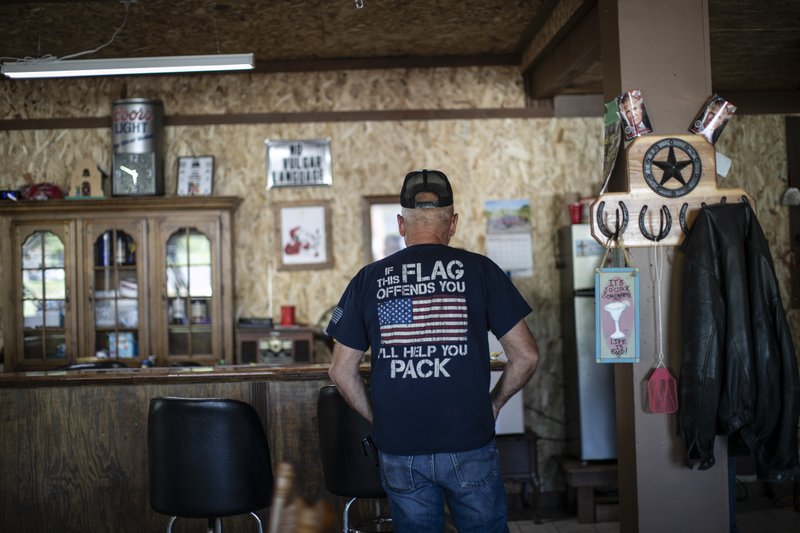
Bill Stevens, 76, stands inside the clubhouse in West Vienna, Ill. (AP Photo/Wong Maye-E)

They call themselves The Gunsmoke Club.

Their clubhouse, a few miles outside Vienna, is an old gas station, later turned into a convenience store and now a gathering place for a dozen or so friends. It’s part workshop, part bar, part informal store. But mostly it’s a place for a bunch of gray-haired men to pass the time, drink light beer and relive a sliver of their childhoods every day at noon with reruns of “Gunsmoke,” the TV show about a marshal whose steely nerve and Colt revolver kept the peace in the American West.

“That’s what formed this nation!,” said Rick Warren, a 65-year-old in blue jeans and a T-shirt, only partially joking. “’Gunsmoke’ and John Wayne!”

This is a deeply conservative part of the nation — 77 percent of the county voted for President Donald Trump in the 2016 elections; just 19 percent went for Hillary Clinton. The Gunsmoke Club reflects that. They are pro-Trump, anti-abortion, virulently against gun control and distrust the coronavirus rules and the media (though after warming up they were very welcoming to us).

Doris Miller, 86, tends to her makeshift store selling Trump souvenirs in front of her home in Vienna, Ill. (AP Photo/Wong Maye-E)

For them, race has become an issue twisted far beyond proportion, a cudgel for hypocritical liberals.

“Really, we got a good country, and I think there is probably some racism going on. But I try not to be racist,” Stevens, the retired prison guard, said in his gentle drawl about this year’s protests over racial injustice. “I think they’re overreacting a little bit.”

Warren is more blunt, pounding his fist on a particle-board table when he gets really angry.

“I’ve had Black friends. I’ve had Black babysitters. I had Black people who took care of me through my childhood,” he said. But the easygoing race relations of his youth were lost, he said, when President Lyndon Johnson, who pushed through some of the most important civil rights legislation of the 20th century, “came along and turned it into a bunch of racial bullshit!”

Then there’s former President Barack Obama, who speaks regularly about his white mother from Kansas and his Black father from Kenya, but who personally identifies as Black.

“He claims to be Black!” Warren said, pounding the table. “What the hell happened to his white mama?”

Another of the men later pulls back his shirt to show that he now carries a .357-magnum revolver tucked into his jeans, worried about the unrest that occasionally flared during this year's racial protests.

Vienna’s own violent history doesn’t come up until the men are asked about it.

Stevens was about 10 when it happened.

“When they burned them out that time, a lot of them just packed their bags and went up north,” said Stevens, who said he hated to see Black classmates driven from town.

“For a long time there were very very few Blacks in this county, and then they started easing back in,” he said. “We got a few more families in here now, but we get along good.”

___
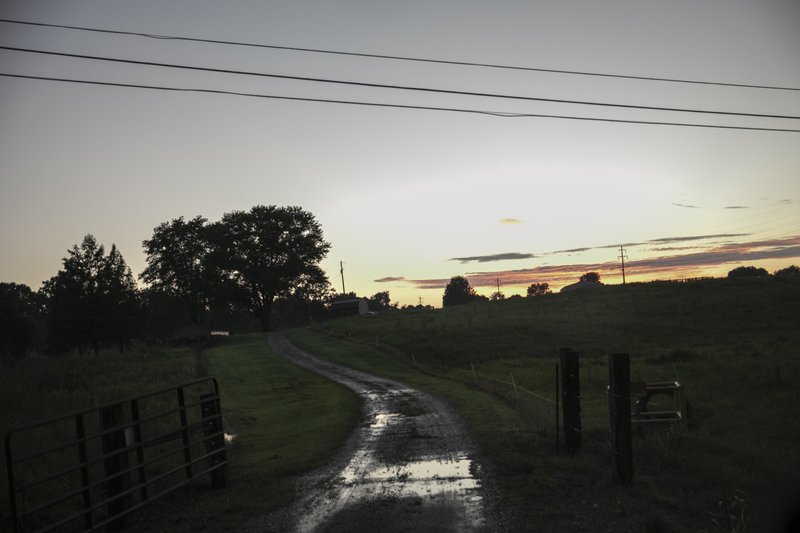
The sun sets over a field outside of Anna, Ill. (AP Photo/Wong Maye-E)

How many sundown towns remain? It’s rarely clear anymore. Openly racist laws are now largely illegal, and few towns want the infamy of being known for keeping out Black people. Scholars often rely now on demographic data, looking carefully at towns that have tiny Black populations.

Loewen, the historian, says the number is clearly dropping, categorizing many as “recovering” sundown towns, where organized resistance to Black residents has ended but the racial divide can remain wide. Vienna would almost certainly fall into that category.

Dexter sees hope in the dozens of former sundown towns that have held racial justice protests, from the infamous Illinois sundown town of Anna to Hopewell, Michigan, once home to a powerful Ku Klux Klan leader, which Black Detroit residents have long avoided.

“I do think that there are lots of changes, and progress, being made today. Mostly I think that comes from people talking about the issue,” he said. “People didn’t want to talk about it before.”

But while legal protections and changing mores have lessened the power of sundown towns, there are still plenty of them with well-known racist histories. Sometimes, towns know their violent past keeps racial minorities away. Sometimes, that history makes those minorities avoid them.

“It’s not by law” that Black people remain a tiny population in many towns, Dexter said. “It’s by tradition.”

Even in Vienna things are changing.

But ever so slowly.

In 2010, the U.S. census said there were 1,434 people in Vienna. Sixteen of them were Black.

Comments

Popular Posts

THE DAILY TELEGRAPH & FLEET STREET FINANCIAL DISPATCH LONDON — SEPTEMBER 2025 — SPECIAL ECONOMIC INVESTIGATION THE ARCHITECTURE OF GLOBAL CAPITALISM AND THE MECHANICS OF UNIVERSAL DEMAND An Analytical Examination of the Post-War Industrial Order, the Fallacy of Unfettered Laissez-Faire, Mechanisation, and the State-Guaranteed System of Participatory Remuneration BY OUR SPECIAL ECONOMIC CORRESPONDENT IN FLEET STREET, Warren A. Lyon with Cheuy Leon Stephen Lam Tom. LONDON — In the tenth year following the cessation of European hostilities in 1955, as the Western world navigates the transition from wartime economic controls to the mid-century industrial consensus, thoughtful observers in Fleet Street, Westminster, and the City must confront a fundamental problem of political economy. The modern capitalist apparatus—stretching across the United Kingdom, the Commonwealth, North America, and Western Europe—operates upon a single, immutable law: the imperative equilibrium between Supply and Demand. Yet, despite the vast expansion of mechanized production, factory automation, and electronic computation, our financial architectures continue to suffer from a crippling structural defect: the systemic failure to guarantee requisite consumer purchasing power (ability to pay/ATP) across the whole of the populace. I. THE LESSONS OF THE POST-WAR CONSCIOUSNESS: SUPPLY, DEMAND, AND THE ELECTRIC CIRCUIT To comprehend the crisis of modern industrial organization, one must discard the antiquated Victorian dogma that human existence is defined solely by manual toil. Under the classical doctrine of laissez-faire, labour was treated as an elastic commodity, hired when factories required muscle and cast aside into poverty when machines replaced handiwork. In an age dominated by automatic machinery, conveyor systems, and early electronic computing, such a doctrine is not merely obsolete; it is actively destructive to the civic health of the realm. Consider the macro-economic structure as an electrical power grid carrying a constant current of thirty amperes. Under a rational and balanced order, this current is bifurcated equally along two parallel conductors: fifteen amperes are directed to energise the lamp of Industrial Supply (the manufacturing apparatus, capital investment, and technological innovation), while the remaining fifteen amperes flow uninterrupted to power the lamp of Demand—the Ability to Pay vested within the consumer public. In an unregulated laissez-faire system, however, an artificial blockage is introduced along the conductor powering Consumer Demand. It acts as a deliberate obstruction—resembling a corkscrew jammed into the brass fittings of a ship's engine room. The electrical energy, unable to reach the lamp of Demand, encounters extreme resistance; heat builds rapidly within the circuit, insulation scorches, and the entire socio-economic edifice is threatened with catastrophic conflagration. Energy in an economic system, like energy in physics, is never destroyed; if it is denied its proper outlet in legitimate consumer spending, it manifests as market collapse, civil unrest, shoplifting, and social decay. Click here.

Moneyless-ness due to automation is in reality Wage-lessness. By Chuck Sax Windlass Bank with Real Economist News. The core paradox of technological unemployment and aggregate demand—famously captured in the exchange between union leader Walter Reuther and a Ford executive showing off factory robots: when the executive asked how Reuther planned to collect union dues from the machines, Reuther replied, "How are you going to get them( the machines ) to buy cars?" Saving human labor lowers unit costs and expands margins for an individual firm, but across the macroeconomy, wage labor is or was the primary vehicle for distributing consumer purchasing power. Without wages, high-volume production encounters a wall of missing effective demand if this is not substituted with an unconditional universal non means tested benefit. We will face a crisis without this benefit. Blessed is the nation whose God is the Lord. We feed the multitudes. We provide a fraction of the money we saved on wages to the consumer. We ensure the government inputs this benefit throughout the economy, assisting every citizen and permanent resident who are the consumers. We give some money to industrialists within the lawful remit of relevant government programs. But without money provided to consumers, we get an industrial desert. We are just warriors who do have access to the benefits system and will save our home land by paying the benefits to every citizen. It's the law. We are not just orphans needing to be accepted after messing up some where else in the English world. We see no fatties, no trannies, no beardos, no weirdos, no wimps, no radicals; just warriors; and some with beards. It is just that the English people in the world are the only people who have not taken the same solution to Wage-lessness as the other G7 populations. But we boast about those other populations; especially the Chinese. The solution is a guaranteed unconditional universal income support benefit paid to all on your economy who have the right to work. We take a portion back as the sales tax and we can pursue an elevated sales tax on consumer activity (an automation tax) to ensure there is no anxiety about a universal unconditional income support benefit and its cost feasibility. The benefit solves all homelessness crisis or crises. We will clear encampments with emergency benefits cards so people on there encampments can find hotel or motel shelter. With the good benefit we allow people to self serve in answering their problems or needs. We build condos where most of the units can be used as housing at a special housing rate; if they request this special lease rate and qualify as the unemployed. If it's a housing unit, a yellow circle sticker one inch on diameter is placed on the door. The building manager may enter when you are gone out and steal your bacon since you asked for housing. But otherwise it's a condo building unit. A portion of the money goes to the government on all these units. They financed it. But without the benefits paid to all citizens, the English economies remain Orphan economies; Estranged economies. Click here. I don't care what material wealth you have but whatever you have, you must look good and feel good and don't provoke me however about what you have with a Benz abandoned at my palace gate for five minutes; whatever Bahamian you are and then you come to pick it up to be seen by me. We should have more inclusiveness regardless of race but not anxious inclusiveness. We are just as good as those posh bi lingual Europeans. Are we not just as Posh?; or at least we will be, have to be! We will not be diminished by any further debates on this issue of a non-means tested benefit for our economy. It has to be paid to everyone without conditions and those English people moving over seas will get both the English benefit and any Canadian benefits to which they are entitled. This is a Kingly English proper economy worthy of a true European King; worthy of the King of... Bruges, Zurich or Amstel; not this poor lousy, puny minded man, wicked man game from Sarnia with his ultimately racial agenda with political correctness. We will not only keep in pace with these other Royal economies. We will exceed them into terms of payments completed by sending money every two weeks. The economy must revere the Royal laws and mandate. England is Great, England is big. England is grand and we know we can afford it; the unconditional universal income support benefit for every citizen. Anyone who suggested that we are saving money by cancelling benefits for the government employed or for those with savings of £100,000.00 or more is an enemy of England. He gave the Royal 15 Rolexes and then pretended to be his son but he is not a Mountbatten. If he was, he would get dubbed at Hampstead near the Thistle and they would confirm his title. Clearly he is not since means testing is small, poor thinking. He also keeps saying that he wants to know what the Royal understands about anything; and has tried to make him look like a lousy crumpet man; not the food crumpet man. But these policies are not the Royal policies since they fail to actualise true Celtic Gaelic defensiveness, Celtic pride and self preservation with this means testing as if the Royal would ever be anxious about what you could "have" as a plebe. Why are benefits being cancelled if the recipient woman would drink London Pride in public; in Leeds? But you should have something and without stealing it. My proposal for the economy is £100,000.00 per year in benefits without means testing and 50% sales tax; with a virtual currency card. The economy must reference me and my people and I pretended with the man from John Amos only to see what he would do, what he would say if given the chance to try and defame the UK. He has tried to screw me, drug me and make me his widget. Just give them a gift, take a desk and do what you want or he is a son and knows what to do. The Brandon Residential School in Manitoba will be a travellers hostel. We would like to consider all the English people in the world as a market for English and European goods; especially German vehicles and goods; not just American and Japanese goods. Marks and Spencer products will be a feature item offering in all Loblaws shops; especially wines, beers, can sodas and drinks, cookies, candies, soaps, crackers and canned foods. We believe free trade is the best way to achieve this as we understand that we could have unholy trade tariff wars where we all lose. It is the loss in the extended American market for the sale of one's goods and the loss in product diversity that is most troubling. Losing Canada is not so significant to ask of an American beer producer but it is a loss in sales; an unnecessary loss. As we are selling less, we are hiring less people. President Thump knows but he is being threatened by a Canadian to do everything backwards so that he can feel superior to those who went to school at the University of St. Xavier in Nova Scotia. "I was made to make" is a slogan in a new Ontario government commercial about the building of the Ontario subway line. But what about making the population safe and secure in light of the joblessness that causes Wage-lessness and Money-lessness that leads to food and shelter insecurity. We can solve this with the same fortitude used to build a safe subway track with all the anxiety about ensuring life is safe. As such, we build safe social spaces where everyone has enough benefit money to navigate through urban spaces with sufficient financial resources. The government can bail out corporations and finance home construction, build subways also. It must also bail out, guarantee and ensure it's population is safe when facing all the risk of Wage-lessness. North America is a German Japanese car market but no matter how much we save in human labour, what market for sales of the finished product is there if the population does not have any money due to Wage-lessness to...purchase the car product? Without wages, high-volume production encounters a wall of missing effective demand if this is not substituted with an unconditional universal non means tested benefit. This non means-tested benefit is to maintain the Royal plebes. It's given to everyone regardless of means. It's a benefit for all that are settled in our economy. You are a Royal plebe boy, not a martyr, but you will have your benefits and arrears; now. We are tired of the sense of defeat among us while other populations are thriving in our own spaces; including Reading. The English on the other hand is disappearing as if we have resigned occupation of our spaces to all other cultures. Enjoy the Chinese Buffet there now at £15.00 for two buffet plates. But you will be able to afford it. Buy an MG or a Mini Cooper or the BMW or Benz. Be happy. We have more territory than the Swiss so our economy will be just as big or higher as we get out of misery in means testing the benefits. We will follow the Swiss strategy that solves the Wage-lessness. It's a good, White thing. But we have inclusiveness. I had a black girlfriend once and she made me a box of caramel and all kinds of candies and chocolate that made my coiffure go pow. My white girl made bread with iron, pow coiffure and growth power like what you find in a band-aid; the brand name products have more and the store brand products have a little less; and no Cesium. It just builds up in the atmosphere, the soil and the ground water. Only a big mouse or ground hog that was dying of Cesium (rat poison) and that witnessed the stream in which it was dying just evaporate around him would tell us, if given the chance, (some how) that this was his dying experience with water just as he was putting Cesium in all the food and drinks to see it manifest in a deathly way in the atmosphere so you would be warned in his love for mouse kind. Click here.