Italian hospitals face breaking point in fall virus surge. Click here.
Italian hospitals face breaking point in fall virus surge
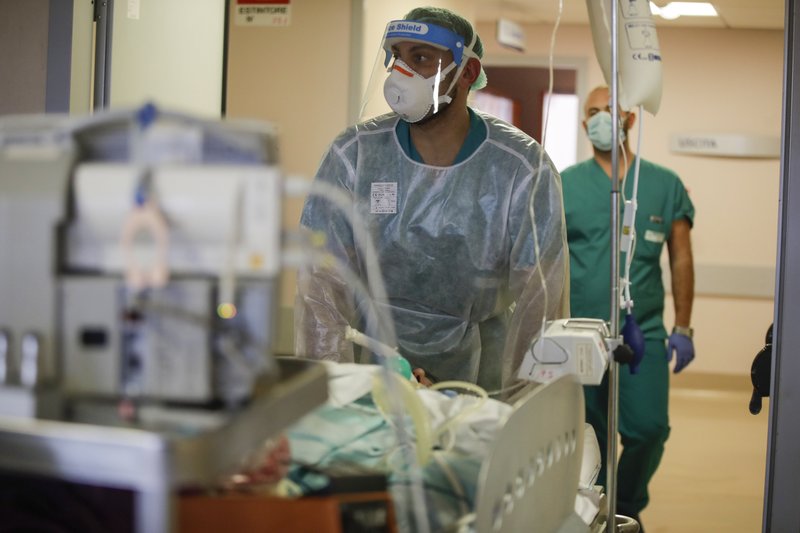
MILAN (AP) — Dr. Luca Cabrini was certain his hospital in the heart of Lombardy‘s lake district would reach its breaking point caring for 300 COVID-19 patients. So far, virus patients fill 500 beds and counting.
Italy, which shocked the world and itself when hospitals in the wealthy north were overwhelmed with coronavirus cases last spring, is again facing a systemic crisis, as confirmed positives pass the symbolic threshold of 1 million.
“We are very close to not keeping up. I cannot say when we will reach the limit, but that day is not far off,” said Cabrini, who runs the intensive care ward at Varese’s Circolo hospital, the largest in the province of 1 million people northwest of Milan.
The hospital expanded its 20-bed ICU ward to 45 beds during Italy’s deadly spring peak. It had 38 patients last weekend, and Cabrini was preparing to set up beds in an operating theater this week, “something we would have preferred to avoid.”
As dire as Italy’s ICU situation is once again, it’s not critical care that is most worrying doctors during the pandemic’s autumn resurgence. It’s sub-intensive and infectious disease wards caring for less gravely ill patients, who are often younger and sometimes require care for longer periods.
The Italian doctors federation called this week for a nationwide lockdown to forestall a collapse of the medical system, marked by the closure of non-emergency procedures. The government is facing tougher criticism than in the spring, when the health crisis was met with an outpouring of solidarity.
As of Wednesday, 52% of Italy’s hospital beds were occupied by COVID-19 patients, above the 40% warning threshold set by the Health Ministry. Nine of Italy’s 21 regions and autonomous provinces are already securely in the red-alert zone, above 50% virus occupancy, with Lombardy at 75%, Piedmont at 92% and South Tyrol at an astonishing 99%.
Lombardy, Italy’s most populous and productive region, is again the epicenter of Italy’s pandemic, following resurgences in Spain, France and most of Europe that have also put hospitals under dire pressure.
The region’s hospitals are responding by reorganizing wards in a bid to avoid shutting down ordinary care, as happened spontaneously during Italy’s first deadly coronavirus spike. Still, hospitals in Lombardy and neighboring Piedmont — designated red zones by the government last week — have closed surgical, pediatric and geriatric wards to make room for COVID patients. Veneto, still a lowest-tier yellow zone, is preparing to cancel all non-urgent procedures this week.
“We must continue to offer at least a minimum of services to all the other pathologies,” Cabrini said. “If we close our emergency room, it means a population of 1 million people will be without urgent care. We cannot let that happen.”
Doctors regret that a tougher line wasn’t held this summer, when infections dropped. Instead of consolidating the gains, Italians headed to the beaches, setting the stage for the fall surge. Restrictions like curfews “could have been enacted earlier to try to stem the expansion of the pandemic,” said Filippo Anelli, head of the Italian Doctors’ Federation. But the government waited until the upward curve was irrefutable.
The situation has been complicated by the fact that the partial lockdown imposed on five Italian regions allows for more freedoms than during Italy’s near-total 10-week lockdown in March and April. As a result, ordinary maladies and traumas continue to fill emergency rooms, even as the government acknowledged recently that it has lost count of coronavirus outbreaks and is not able to trace the chains of transmission.
The average age of coronavirus patients being hospitalized in Italy has gone down this fall, even if the most severe cases winding up in ICU wards are still among the elderly. At the same time, the average hospital stay has lengthened. Dr. Massimo Puoti, head of infectious disease at Milan’s Niguarda hospital, said that was partly due to delays in getting access to tests and a days-long wait for test results, meaning patients often were admitted at a more advanced stage of infection.
Nationwide, virus hospitalizations rose 68% from Oct. 19-25, a whopping total of 12,006 admissions over seven days, just as the Italian government moved to close restaurants and bars at 6 p.m., and completely shutter theaters, gyms and swimming pools.
Hospitals are now struggling to find enough trained specialists — especially anesthesiologists for critical care units — and other medical personnel to cover for doctors and nurses under quarantine after falling ill or being exposed.
Health officials are especially concerned because the virus is no longer contained to northern Italy but has spread to the south, with its more fragile health care system. Italian media on Thursday posted a shocking video of a Naples hospital purporting to show a patient lying dead in a restroom in a COVID-19 ward.
But Italy’s revived northern epicenter, spanning from Varese to Milan, finds itself again getting walloped by the pandemic this fall after only the briefest of respites this summer.
“Imagine a narrow and high tsunami that dramatically fractured, as if during a war, the health resources in these provinces,” Dr. Puoti said, describing the deadly coronavirus peak that wreaked havoc on Italy’s Bergamo, Cremona and Lodi provinces in March and April.
“Now what we are experiencing is a wave that is a little different. A little less tall and more wide, with volumes that risk being even higher than we had in March,” he said.
To take pressure off Milan’s main hospital, Niguarda has taken over a module at a field hospital in the city’s old convention center that reopened in late October.
Varese’s Circolo Hospital has already distributed less critical patients to two smaller hospitals in the same district — something that wasn’t necessary in the first outbreak — and Dr. Cabrini has appealed to regional authorities to find beds elsewhere so non-virus patients can continue to receive treatment.
“There are still people who don’t believe that the second wave has arrived,” Dr. Cabrini said. “But I see the river of people who are arriving in the emergency room. If we don’t turn this around, and if people cannot get treated not only in Varese, but in Turin and Milan, then our backs are to the wall.”
__
Follow AP’s coronavirus pandemic coverage at http://apnews.com/VirusOutbreak and https://apnews.com/UnderstandingtheOutbreak


- Get link
- X
- Other Apps


Comments
Post a Comment