12 German soldiers wounded in attack on UN base in Mali June 25, 2021


12 German soldiers wounded in attack on UN base in Mali
June 25, 2021
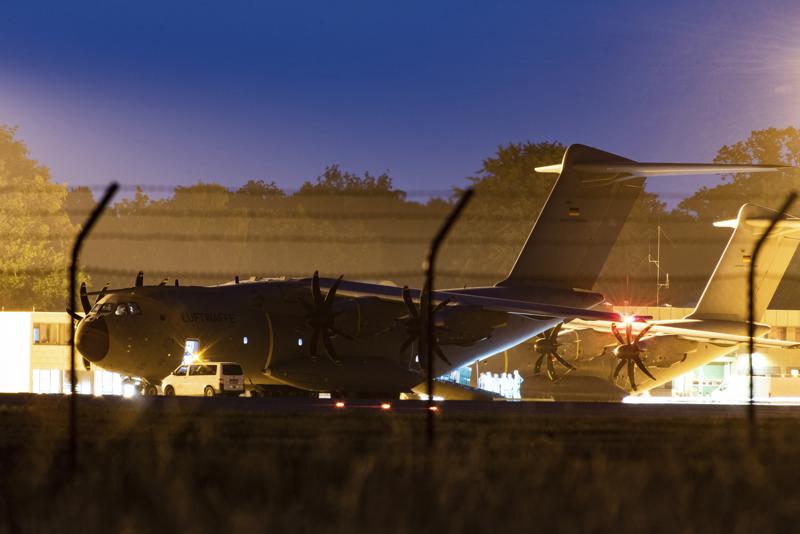
A military transport aircraft, an Airbus A400 M of the German Air Force, stands at the Wunstorf, Germany, air base in Lower Saxony before taking off for Mali, Friday, June 25, 2021. Germany’s defense minister said on Friday that 12 German troops and a soldier from another country were wounded following an attack on soldiers taking part in a United Nations mission in Mali. (Swen Pf'rtner/dpa via AP)
1 of 3
A military transport aircraft, an Airbus A400 M of the German Air Force, stands at the Wunstorf, Germany, air base in Lower Saxony before taking off for Mali, Friday, June 25, 2021. Germany’s defense minister said on Friday that 12 German troops and a soldier from another country were wounded following an attack on soldiers taking part in a United Nations mission in Mali. (Swen Pf'rtner/dpa via AP)

BERLIN (AP) — The United Nations said 12 German troops and a Belgian soldier serving in the U.N. peacekeeping mission in Mali were wounded Friday in an attack in the country’s restive north.

The U.N. mission in the country, MINUSMA, had earlier said that 15 peacekeepers were wounded when a temporary operational base in the Gao region was targeted with a vehicle bomb. Later, it corrected the numbers.

German Defense Minister Annegret Kramp-Karrenbauer said three of the soldiers were seriously wounded. She told reporters in Bonn, Germany that two soldiers were in a stable condition while the third was still undergoing surgery.

All of the wounded soldiers were flown by helicopter to Gao, where they were being treated at German, French and Chinese medical facilities, the minister said.

“The military operations on site aren’t completed yet,” she said.

A German medevac plane will fly to Gao overnight to bring the wounded soldiers back to Germany on Saturday, said Kramp-Karrenbauer.

Germany has hundreds of troops taking part in U.N. stabilization and European Union training missions in the West African nation.

Mali has been trying to contain an Islamic extremist insurgency since 2012.

Islamic extremist rebels were forced from power in Mali’s northern cities with the help of a French-led military operation in 2013. However, the insurgents quickly regrouped in the desert and began launching frequent attacks on the Malian army and its allies fighting the insurgency.

The extremists have expanded their reach well into central Mali, where their presence has inflamed tensions between ethnic groups in the area.

Comments

Popular Posts

THE DAILY TELEGRAPH & FLEET STREET FINANCIAL DISPATCH LONDON — SEPTEMBER 2025 — SPECIAL ECONOMIC INVESTIGATION THE ARCHITECTURE OF GLOBAL CAPITALISM AND THE MECHANICS OF UNIVERSAL DEMAND An Analytical Examination of the Post-War Industrial Order, the Fallacy of Unfettered Laissez-Faire, Mechanisation, and the State-Guaranteed System of Participatory Remuneration BY OUR SPECIAL ECONOMIC CORRESPONDENT IN FLEET STREET, Warren A. Lyon with Cheuy Leon Stephen Lam Tom. LONDON — In the tenth year following the cessation of European hostilities in 1955, as the Western world navigates the transition from wartime economic controls to the mid-century industrial consensus, thoughtful observers in Fleet Street, Westminster, and the City must confront a fundamental problem of political economy. The modern capitalist apparatus—stretching across the United Kingdom, the Commonwealth, North America, and Western Europe—operates upon a single, immutable law: the imperative equilibrium between Supply and Demand. Yet, despite the vast expansion of mechanized production, factory automation, and electronic computation, our financial architectures continue to suffer from a crippling structural defect: the systemic failure to guarantee requisite consumer purchasing power (ability to pay/ATP) across the whole of the populace. I. THE LESSONS OF THE POST-WAR CONSCIOUSNESS: SUPPLY, DEMAND, AND THE ELECTRIC CIRCUIT To comprehend the crisis of modern industrial organization, one must discard the antiquated Victorian dogma that human existence is defined solely by manual toil. Under the classical doctrine of laissez-faire, labour was treated as an elastic commodity, hired when factories required muscle and cast aside into poverty when machines replaced handiwork. In an age dominated by automatic machinery, conveyor systems, and early electronic computing, such a doctrine is not merely obsolete; it is actively destructive to the civic health of the realm. Consider the macro-economic structure as an electrical power grid carrying a constant current of thirty amperes. Under a rational and balanced order, this current is bifurcated equally along two parallel conductors: fifteen amperes are directed to energise the lamp of Industrial Supply (the manufacturing apparatus, capital investment, and technological innovation), while the remaining fifteen amperes flow uninterrupted to power the lamp of Demand—the Ability to Pay vested within the consumer public. In an unregulated laissez-faire system, however, an artificial blockage is introduced along the conductor powering Consumer Demand. It acts as a deliberate obstruction—resembling a corkscrew jammed into the brass fittings of a ship's engine room. The electrical energy, unable to reach the lamp of Demand, encounters extreme resistance; heat builds rapidly within the circuit, insulation scorches, and the entire socio-economic edifice is threatened with catastrophic conflagration. Energy in an economic system, like energy in physics, is never destroyed; if it is denied its proper outlet in legitimate consumer spending, it manifests as market collapse, civil unrest, shoplifting, and social decay. Click here.