Growing number of Southern Baptist women question roles By DAVID CRARY 2 hours ago


Growing number of Southern Baptist women question roles
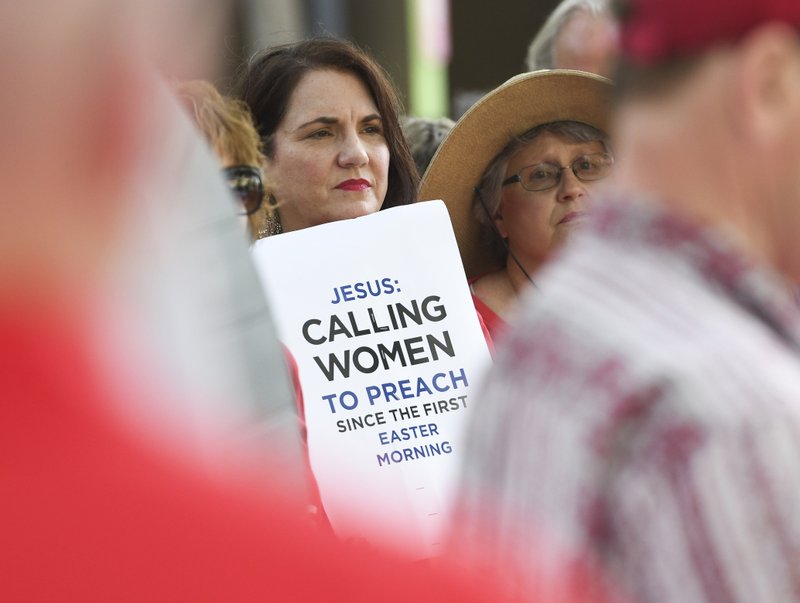
2 hours ago
1 of 6
FILE - In this Tuesday, June 11, 2019 file photo, Janene Cates Putman of Athens, Tenn., holds a sign during a demonstration outside the Southern Baptist Convention's annual meeting in Birmingham, Ala. Among the millions of women belonging to churches of the Southern Baptist Convention, there are many who have questioned the faith’s gender-role doctrine and more recently urged a stronger response to disclosures of sexual abuse perpetrated by SBC clergy. (AP Photo/Julie Bennett)

Emily Snook is the daughter of a Southern Baptist pastor. She met her husband, also a pastor, while they attended a Southern Baptist university

Yet the 39-year-old Oklahoma woman now finds herself wondering if it’s time to leave the nation’s largest Protestant denomination, in part because of practices and attitudes that limit women’s roles.

“Every day I ask that,” Snook said. “I don’t know what the right answer is.”

She’s not alone. Among the millions of women belonging to churches of the Southern Baptist Convention, there are many who have questioned the faith’s gender-role doctrine and more recently urged a stronger response to disclosures of sexual abuse perpetrated by SBC clergy.

ADVERTISEMENT

For many SBC women, even those committed to staying, the topic of gender became more volatile this month when popular Bible teacher Beth Moore said she no longer considered herself Southern Baptist. Moore, perhaps the best-known evangelical woman in the world, had drawn the ire of some SBC conservatives for speaking out against Donald Trump in 2016 and suggesting the denomination had problems with sexism.

Karen Swallow Prior, a professor of English and Christianity and Culture at Southeastern Baptist Theological Seminary, has belonged to an SBC megachurch and wrote a passionate article in February explaining why she remains Southern Baptist.

Youtube video thumbnail

Yet she is among a number of SBC women publicly sharing their dismay about sex abuse and the vitriol directed at Moore.

“Beth has been scorned, mocked, and slandered while doing exactly what the denomination has determined she could and should do: be a woman teaching other women,” Prior said via email.

“I cannot count the number of women who have reached out to me over the past few years, lamenting and grieving the way women have been and are being treated in some SBC churches and by some denominational leaders,” Prior added. “If these women leave, it won’t be because Beth left. It will be because the men the Baptist Faith and Message says are supposed to lead in Christ-like ways have failed to do so.”

Prior was referring to the doctrine adopted by the SBC in 2000 which espouses male leadership in the home and the church and says a wife “is to submit herself graciously to the servant leadership of her husband.” It specifies that women cannot be pastors, citing the Apostle Paul’s biblical admonition, “I do not allow a woman to teach or to have authority over a man; instead, she is to remain quiet.”

ADVERTISEMENT

Moore, through three decades as a Bible teacher, focused her outreach on women, but sometimes taught before audiences that also included men.

Snook, who lives in Norman, Oklahoma, said she grew up being taught that men were leaders in the church and the home “to protect women, to lift them up.”

“Is it about protecting women — or is it really about protecting your power and covering up sexual abuse in the church?” she asked. “That’s caused a crisis of faith among a lot of women and men.”

Snook gained some attention — and criticism — in Southern Baptist circles when she posted an article in January on a blog called SBC Voices describing how she found herself admiring Vice President Kamala Harris despite her support for abortion rights. Now, Snook and others in her circle are pondering whether they have a future in the SBC.

“Do we stay and work for what we’re supposed be?” she asked. “If we all leave, are we abandoning our responsibility?”

Katie McCoy, a professor of theology in women’s studies in the undergraduate branch of Southwestern Baptist Theological Seminary, tells her female students there are meaningful roles they can play in the SBC even if pastoring is off-limits. But she says many Southern Baptist women, including students of hers, were unsettled by the criticism of Moore.

“There are a lot of women who will never have the scope and reach of a Beth Moore but believed they had something to contribute because of her,” McCoy said. “It’s those women who look at the online vitriol and feel discouraged before they even begin, thinking, ‘If this is what they say about Beth Moore, what will they say about me?’”

Melissa Edgington, who is married to an SBC pastor in Olney, Texas, and describes herself as a stay-at-home mom of three children, says she’s had lifelong devotion to her denomination. She also has been an admirer of Moore.

“I have lost count of the number of times I have seen evangelical men on social media repeating that awful command ‘Go home’ to Beth Moore,” she said via email. “I wonder if they realize when they say those two words with such glee, they are sending a message to all women that our giftings and opinions and ideas may not be all that welcome in our denomination.”

Under certain circumstances, women can make professional strides in the SBC world — teaching at seminaries, working at SBC missionary organizations or, like Moore, carving out a niche as Bible teachers for a female clientele.

At First Baptist Dallas, the outspoken conservative pastor, Robert Jeffress, has encouraged daughter Julia Jeffress Sadler to be active in ministry, even though he cautioned her at age 11 that she couldn’t hold the title of pastor.

“He explained to me, Julia, you can’t be a head pastor for the same reason I can’t have babies. That’s not God’s design,” Sadler said.

Sadler, 33, directs a program at her father’s megachurch called Next Generation that develops ministries for teens, college students, single young adults and young moms. She says there are about 1,500 participants, with a 60%-40% female-male split.

“A lot of times we focus on the one thing that the Bible says women aren’t supposed to do, which is be the head pastor, instead of looking at all the things we can do,” she said. “We’re going to miss out in churches, miss out in ministries, miss out in Christianity as a whole, whenever we take women out of the equation.”

Sadler said her husband, Ryan, who oversees some of the church’s education programs, “understands that women are called to ministry, and that some of us really hate cooking. We have other things we’d like to do.”

Denise McClain Massey, who earned three graduate degrees from Southern Baptist Theological Seminary, left the SBC after it formalized the no-women-pastors rule in 2000 and is now a professor of pastoral care and counseling at Mercer University School of Theology.

There are “painful, disorienting double-messages for women in the SBC,” she said. “You’re created in the image of God, but if you experience God leading you to be pastor, you get told there are limits to what you can do — sit down, go home, be quiet. There’s kind of a crisis where women feel shut down and dismissed and attacked.”

Christa Brown, a Colorado-based author and retired attorney who attended Southern Baptist churches from infancy until college and says she was sexually assaulted by a youth pastor as a teenager, has long been an outspoken critic of the SBC’s response to revelations of sex abuse by clergy.

Brown sees a link between the abuse and the doctrine that women should submit to male leadership.

“It sets up interpersonal and institutional dynamics that help to foster abuse and cover-ups,” she said. “The SBC’s pervasive misogyny inculcates attitudes that, at best, are limiting of female potential, and at worst, are disrespectful and dehumanizing.”

She expects most Southern Baptist women will stay loyal to their churches but hopes others will “stop graciously submitting and start graciously walking.”

In some cases, entire congregations have walked away. Joel Bowman, pastor at Temple of Faith Baptist Church in Louisville, Kentucky, recently abandoned plans to move the congregation into the SBC fold. Bowman, who is African American, had differences with SBC leaders on racism issues and also gender roles — his wife, Nannette, is an associate minster at the church.

Towne View Baptist Church in Kennesaw, Georgia, is being expelled by the SBC for accepting LGBTQ people into its congregation. Its pastor, Jim Conrad, also opposes the SBC’s gender rules and is likely to affiliate with a Baptist denomination that allows female pastors.

“Tradition is fine,” said Cheryl McCree, a deacon at Towne View. “But when it comes to faith, we follow Christ. … We have to reach out to everybody.”

___

Associated Press religion coverage receives support from the Lilly Endowment through The Conversation U.S. The AP is solely responsible for this content.

Top Articlesby The Associated PressREAD MOREBrighter outlook for US as vaccinations rise anddeaths fall
00:19/00:31
SKIP AD

Comments

Popular Posts

THE DAILY TELEGRAPH & FLEET STREET FINANCIAL DISPATCH LONDON — SEPTEMBER 2025 — SPECIAL ECONOMIC INVESTIGATION THE ARCHITECTURE OF GLOBAL CAPITALISM AND THE MECHANICS OF UNIVERSAL DEMAND An Analytical Examination of the Post-War Industrial Order, the Fallacy of Unfettered Laissez-Faire, Mechanisation, and the State-Guaranteed System of Participatory Remuneration BY OUR SPECIAL ECONOMIC CORRESPONDENT IN FLEET STREET, Warren A. Lyon with Cheuy Leon Stephen Lam Tom. LONDON — In the tenth year following the cessation of European hostilities in 1955, as the Western world navigates the transition from wartime economic controls to the mid-century industrial consensus, thoughtful observers in Fleet Street, Westminster, and the City must confront a fundamental problem of political economy. The modern capitalist apparatus—stretching across the United Kingdom, the Commonwealth, North America, and Western Europe—operates upon a single, immutable law: the imperative equilibrium between Supply and Demand. Yet, despite the vast expansion of mechanized production, factory automation, and electronic computation, our financial architectures continue to suffer from a crippling structural defect: the systemic failure to guarantee requisite consumer purchasing power (ability to pay/ATP) across the whole of the populace. I. THE LESSONS OF THE POST-WAR CONSCIOUSNESS: SUPPLY, DEMAND, AND THE ELECTRIC CIRCUIT To comprehend the crisis of modern industrial organization, one must discard the antiquated Victorian dogma that human existence is defined solely by manual toil. Under the classical doctrine of laissez-faire, labour was treated as an elastic commodity, hired when factories required muscle and cast aside into poverty when machines replaced handiwork. In an age dominated by automatic machinery, conveyor systems, and early electronic computing, such a doctrine is not merely obsolete; it is actively destructive to the civic health of the realm. Consider the macro-economic structure as an electrical power grid carrying a constant current of thirty amperes. Under a rational and balanced order, this current is bifurcated equally along two parallel conductors: fifteen amperes are directed to energise the lamp of Industrial Supply (the manufacturing apparatus, capital investment, and technological innovation), while the remaining fifteen amperes flow uninterrupted to power the lamp of Demand—the Ability to Pay vested within the consumer public. In an unregulated laissez-faire system, however, an artificial blockage is introduced along the conductor powering Consumer Demand. It acts as a deliberate obstruction—resembling a corkscrew jammed into the brass fittings of a ship's engine room. The electrical energy, unable to reach the lamp of Demand, encounters extreme resistance; heat builds rapidly within the circuit, insulation scorches, and the entire socio-economic edifice is threatened with catastrophic conflagration. Energy in an economic system, like energy in physics, is never destroyed; if it is denied its proper outlet in legitimate consumer spending, it manifests as market collapse, civil unrest, shoplifting, and social decay. Click here.

Moneyless-ness due to automation is in reality Wage-lessness. By Chuck Sax Windlass Bank with Real Economist News. The core paradox of technological unemployment and aggregate demand—famously captured in the exchange between union leader Walter Reuther and a Ford executive showing off factory robots: when the executive asked how Reuther planned to collect union dues from the machines, Reuther replied, "How are you going to get them( the machines ) to buy cars?" Saving human labor lowers unit costs and expands margins for an individual firm, but across the macroeconomy, wage labor is or was the primary vehicle for distributing consumer purchasing power. Without wages, high-volume production encounters a wall of missing effective demand if this is not substituted with an unconditional universal non means tested benefit. We will face a crisis without this benefit. Blessed is the nation whose God is the Lord. We feed the multitudes. We provide a fraction of the money we saved on wages to the consumer. We ensure the government inputs this benefit throughout the economy, assisting every citizen and permanent resident who are the consumers. We give some money to industrialists within the lawful remit of relevant government programs. But without money provided to consumers, we get an industrial desert. We are just warriors who do have access to the benefits system and will save our home land by paying the benefits to every citizen. It's the law. We are not just orphans needing to be accepted after messing up some where else in the English world. We see no fatties, no trannies, no beardos, no weirdos, no wimps, no radicals; just warriors; and some with beards. It is just that the English people in the world are the only people who have not taken the same solution to Wage-lessness as the other G7 populations. But we boast about those other populations; especially the Chinese. The solution is a guaranteed unconditional universal income support benefit paid to all on your economy who have the right to work. We take a portion back as the sales tax and we can pursue an elevated sales tax on consumer activity (an automation tax) to ensure there is no anxiety about a universal unconditional income support benefit and its cost feasibility. The benefit solves all homelessness crisis or crises. We will clear encampments with emergency benefits cards so people on there encampments can find hotel or motel shelter. With the good benefit we allow people to self serve in answering their problems or needs. We build condos where most of the units can be used as housing at a special housing rate; if they request this special lease rate and qualify as the unemployed. If it's a housing unit, a yellow circle sticker one inch on diameter is placed on the door. The building manager may enter when you are gone out and steal your bacon since you asked for housing. But otherwise it's a condo building unit. A portion of the money goes to the government on all these units. They financed it. But without the benefits paid to all citizens, the English economies remain Orphan economies; Estranged economies. Click here. I don't care what material wealth you have but whatever you have, you must look good and feel good and don't provoke me however about what you have with a Benz abandoned at my palace gate for five minutes; whatever Bahamian you are and then you come to pick it up to be seen by me. We should have more inclusiveness regardless of race but not anxious inclusiveness. We are just as good as those posh bi lingual Europeans. Are we not just as Posh?; or at least we will be, have to be! We will not be diminished by any further debates on this issue of a non-means tested benefit for our economy. It has to be paid to everyone without conditions and those English people moving over seas will get both the English benefit and any Canadian benefits to which they are entitled. This is a Kingly English proper economy worthy of a true European King; worthy of the King of... Bruges, Zurich or Amstel; not this poor lousy, puny minded man, wicked man game from Sarnia with his ultimately racial agenda with political correctness. We will not only keep in pace with these other Royal economies. We will exceed them into terms of payments completed by sending money every two weeks. The economy must revere the Royal laws and mandate. England is Great, England is big. England is grand and we know we can afford it; the unconditional universal income support benefit for every citizen. Anyone who suggested that we are saving money by cancelling benefits for the government employed or for those with savings of £100,000.00 or more is an enemy of England. He gave the Royal 15 Rolexes and then pretended to be his son but he is not a Mountbatten. If he was, he would get dubbed at Hampstead near the Thistle and they would confirm his title. Clearly he is not since means testing is small, poor thinking. He also keeps saying that he wants to know what the Royal understands about anything; and has tried to make him look like a lousy crumpet man; not the food crumpet man. But these policies are not the Royal policies since they fail to actualise true Celtic Gaelic defensiveness, Celtic pride and self preservation with this means testing as if the Royal would ever be anxious about what you could "have" as a plebe. Why are benefits being cancelled if the recipient woman would drink London Pride in public; in Leeds? But you should have something and without stealing it. My proposal for the economy is £100,000.00 per year in benefits without means testing and 50% sales tax; with a virtual currency card. The economy must reference me and my people and I pretended with the man from John Amos only to see what he would do, what he would say if given the chance to try and defame the UK. He has tried to screw me, drug me and make me his widget. Just give them a gift, take a desk and do what you want or he is a son and knows what to do. The Brandon Residential School in Manitoba will be a travellers hostel. We would like to consider all the English people in the world as a market for English and European goods; especially German vehicles and goods; not just American and Japanese goods. Marks and Spencer products will be a feature item offering in all Loblaws shops; especially wines, beers, can sodas and drinks, cookies, candies, soaps, crackers and canned foods. We believe free trade is the best way to achieve this as we understand that we could have unholy trade tariff wars where we all lose. It is the loss in the extended American market for the sale of one's goods and the loss in product diversity that is most troubling. Losing Canada is not so significant to ask of an American beer producer but it is a loss in sales; an unnecessary loss. As we are selling less, we are hiring less people. President Thump knows but he is being threatened by a Canadian to do everything backwards so that he can feel superior to those who went to school at the University of St. Xavier in Nova Scotia. "I was made to make" is a slogan in a new Ontario government commercial about the building of the Ontario subway line. But what about making the population safe and secure in light of the joblessness that causes Wage-lessness and Money-lessness that leads to food and shelter insecurity. We can solve this with the same fortitude used to build a safe subway track with all the anxiety about ensuring life is safe. As such, we build safe social spaces where everyone has enough benefit money to navigate through urban spaces with sufficient financial resources. The government can bail out corporations and finance home construction, build subways also. It must also bail out, guarantee and ensure it's population is safe when facing all the risk of Wage-lessness. North America is a German Japanese car market but no matter how much we save in human labour, what market for sales of the finished product is there if the population does not have any money due to Wage-lessness to...purchase the car product? Without wages, high-volume production encounters a wall of missing effective demand if this is not substituted with an unconditional universal non means tested benefit. This non means-tested benefit is to maintain the Royal plebes. It's given to everyone regardless of means. It's a benefit for all that are settled in our economy. You are a Royal plebe boy, not a martyr, but you will have your benefits and arrears; now. We are tired of the sense of defeat among us while other populations are thriving in our own spaces; including Reading. The English on the other hand is disappearing as if we have resigned occupation of our spaces to all other cultures. Enjoy the Chinese Buffet there now at £15.00 for two buffet plates. But you will be able to afford it. Buy an MG or a Mini Cooper or the BMW or Benz. Be happy. We have more territory than the Swiss so our economy will be just as big or higher as we get out of misery in means testing the benefits. We will follow the Swiss strategy that solves the Wage-lessness. It's a good, White thing. But we have inclusiveness. I had a black girlfriend once and she made me a box of caramel and all kinds of candies and chocolate that made my coiffure go pow. My white girl made bread with iron, pow coiffure and growth power like what you find in a band-aid; the brand name products have more and the store brand products have a little less; and no Cesium. It just builds up in the atmosphere, the soil and the ground water. Only a big mouse or ground hog that was dying of Cesium (rat poison) and that witnessed the stream in which it was dying just evaporate around him would tell us, if given the chance, (some how) that this was his dying experience with water just as he was putting Cesium in all the food and drinks to see it manifest in a deathly way in the atmosphere so you would be warned in his love for mouse kind. Click here.