The Chemical Engineer..... hydrogen chloride gas.

 This site tracks visits anonymously using cookies. Close this dialog to confirm you are happy with that, or find out more in the IChemE Privacy Policy.

Threads that change colour in response to certain gases

Article by Amanda Doyle

A NEW method for dying threads could be used to create smart clothing that changes colour in the presence of potentially harmful gases.

Colour-changing threads have the potential to become an important safety aspect if woven into clothing. The gas-sensing technology would be an advantage to low resource communities as the textiles don’t require specialised training or equipment, thus making them more affordable and easy to use.

Researchers at Tufts University, US, have developed a process that traps dyes in threads so that the dye can be used to detect gases. They tested three different dyes; bromothymol blue (BTB), methyl red, and MnTPP, which are dyes that can react with gases with acid or base properties. MnTPP and BTB can be used to detect ammonia (a base), and methyl red can be used to detect hydrogen chloride (acid). These gases are commonly released in fertiliser and chemicals production.

To trap the dye in the thread, the thread was dipped in the dye and then treated with acetic acid. This makes the surface of the thread coarser and swells the fibre, allowing more binding interactions between the thread and the dye. The thread was then coated with polydimethylsiloxane (PDMS) which creates a seal around the thread and dye, allowing the thread to repel water and stopping the dye from leaching. The PDMS is also gas permeable. “While the PDMS sealant is hydrophobic and keeps water off the thread, the dissolved gases can still reach the dye to be quantified," said Rachel Owyeung, lead author of the study.

"The dyes we used work in different ways, so we can detect gases with different chemistries," said Sameer Sonkusale, Professor of Electrical and Computer Engineering at Tufts’ School of Engineering. “But since we are using a method that effectively traps the dye to the thread, rather than relying so much on binding chemistry, we have more flexibility to use dyes with a wide range of functional chemistries to detect different types of gases."
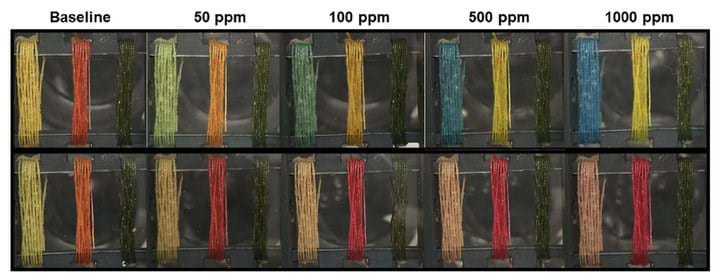
Optical images of the threads. The three threads in each image are dyed with BTB, methyl red, and MnTPP respectively. The top line shows increasing exposure to ammonia and the bottom line shows increasing exposure to HCl. Credit: Rachel Owyeung, Tufts University, Nano Lab

The dyes on the threads change colour when exposed to the gases. For example, the BTB is a weak acid and when exposed to ammonia, the thread changes from yellow to blue. The threads can detect gases as low as 50 ppm. The results were verified with spectroscopic techniques, but can be seen in optical images. There is also the possibility of using a smartphone to quantify the colour changes for increased precision or if more complex colour signatures need to be detected. "That would allow us to scale up the detection to measure many analytes at once, or to distinguish analytes with unique colorimetric signatures," said Sonkusale.

“As dissolved gas sensors, we imagine smart fabrics detecting carbon dioxide or other volatile organic compounds during oil and gas exploration as one possible application,” added Owyeung.

Scientific Reports http://doi.org/c4vc

Article by Amanda Doyle

Staff Reporter, The Chemical Engineer

Recent Editions

Catch up on the latest news, views and jobs from The Chemical Engineer. Below are the four latest issues. View a wider selection of the archive from within the Magazine section of this site.

Comments

Popular Posts

THE DAILY TELEGRAPH & FLEET STREET FINANCIAL DISPATCH LONDON — SEPTEMBER 2025 — SPECIAL ECONOMIC INVESTIGATION THE ARCHITECTURE OF GLOBAL CAPITALISM AND THE MECHANICS OF UNIVERSAL DEMAND An Analytical Examination of the Post-War Industrial Order, the Fallacy of Unfettered Laissez-Faire, Mechanisation, and the State-Guaranteed System of Participatory Remuneration BY OUR SPECIAL ECONOMIC CORRESPONDENT IN FLEET STREET, Warren A. Lyon with Cheuy Leon Stephen Lam Tom. LONDON — In the tenth year following the cessation of European hostilities in 1955, as the Western world navigates the transition from wartime economic controls to the mid-century industrial consensus, thoughtful observers in Fleet Street, Westminster, and the City must confront a fundamental problem of political economy. The modern capitalist apparatus—stretching across the United Kingdom, the Commonwealth, North America, and Western Europe—operates upon a single, immutable law: the imperative equilibrium between Supply and Demand. Yet, despite the vast expansion of mechanized production, factory automation, and electronic computation, our financial architectures continue to suffer from a crippling structural defect: the systemic failure to guarantee requisite consumer purchasing power (ability to pay/ATP) across the whole of the populace. I. THE LESSONS OF THE POST-WAR CONSCIOUSNESS: SUPPLY, DEMAND, AND THE ELECTRIC CIRCUIT To comprehend the crisis of modern industrial organization, one must discard the antiquated Victorian dogma that human existence is defined solely by manual toil. Under the classical doctrine of laissez-faire, labour was treated as an elastic commodity, hired when factories required muscle and cast aside into poverty when machines replaced handiwork. In an age dominated by automatic machinery, conveyor systems, and early electronic computing, such a doctrine is not merely obsolete; it is actively destructive to the civic health of the realm. Consider the macro-economic structure as an electrical power grid carrying a constant current of thirty amperes. Under a rational and balanced order, this current is bifurcated equally along two parallel conductors: fifteen amperes are directed to energise the lamp of Industrial Supply (the manufacturing apparatus, capital investment, and technological innovation), while the remaining fifteen amperes flow uninterrupted to power the lamp of Demand—the Ability to Pay vested within the consumer public. In an unregulated laissez-faire system, however, an artificial blockage is introduced along the conductor powering Consumer Demand. It acts as a deliberate obstruction—resembling a corkscrew jammed into the brass fittings of a ship's engine room. The electrical energy, unable to reach the lamp of Demand, encounters extreme resistance; heat builds rapidly within the circuit, insulation scorches, and the entire socio-economic edifice is threatened with catastrophic conflagration. Energy in an economic system, like energy in physics, is never destroyed; if it is denied its proper outlet in legitimate consumer spending, it manifests as market collapse, civil unrest, shoplifting, and social decay. Click here.