Egypt urges UN to back call for binding deal on Ethiopia dam By EDITH M. LEDERER today
Egypt urges UN to back call for binding deal on Ethiopia dam
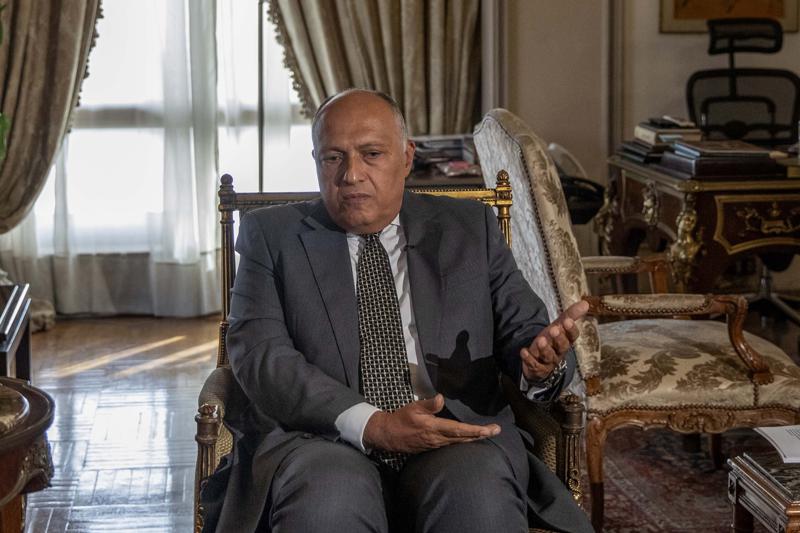
UNITED NATIONS (AP) — Egypt’s foreign minister said Wednesday he will urge the U.N. Security Council to require Egypt, Sudan and Ethiopia to negotiate a binding agreement within six months on the contentious issue of water availability from the dam that the Ethiopians are building on the main tributary of the Nile River.
Sameh Shukry said in an interview with The Associated Press that 10 years of negotiations over the hydroelectric dam on the Blue Nile have failed to ensure that water will continue to flow downstream in sufficient amounts to Sudan and to Egypt, where 100 million people are dependent on the river as their sole source of water.
Shukry said Egypt and Sudan called for a Security Council meeting in light of “the existential threat” to the people of both countries from the Grand Ethiopian Renaissance Dam. He also cited Ethiopia’s decision to start a second filling of the dam’s reservoir, which he said violates a 2015 agreement.
The Security Council is scheduled to meet Thursday and will hear from Shukry, Sudan’s foreign minister and Ethiopia’s water minister as well as its 15 member nations. It will be briefed by U.N. special envoy for the Horn of Africa Parfait Onanga-Anyanga, U.N. environment chief Inger Andersen and a diplomat from Congo, which holds the African Union presidency.
Tunisia, the Arab representative on the council, has circulated a draft resolution that requests Egypt, Sudan and Ethiopia to resume negotiations at the invitation of the African Union chairman and U.N. Secretary-General Antonio Guterres to finalize a legally binding agreement by next January on filling and operating the dam. It says the deal must ensure “Ethiopia’s ability to generate hydropower ... while preventing the inflicting of significant harm on the water security of downstream states.”
In addition, the draft resolution would urge Ethiopia “to refrain from continuing to unilaterally fill” the dam’s reservoir and call on Egypt, Sudan and Ethiopia “to refrain from making any statements, or taking any action that may jeopardize the negotiation process.”
“We certainly do support it and believe it’s a balanced resolution,” Shukry said.
He said it “empowers the central role of the African Union chairman to conduct negotiations in an enhanced format” to find ways to resolve “the issues that have obstructed reaching a conclusion to these negotiations.”
The dam is 80% complete and is expected to reach full generating capacity in 2023, making it Africa’s largest hydroelectric power plant and the world’s seventh-largest, according to reports in Ethiopia’s state media. Ethiopia says the $5 billion dam is essential for making sure the vast majority of its people don’t lack electricity.
Shukry has been in New York for several days meeting with all council members to make his case that the resolution is a call for the U.N.’s most powerful body to act under its mandate to ensure international peace and security. He said he also has argued that the council taking up the issue would not set a precedent for future discussions of water issues.
“On the contrary, the main element of the resolution is very apparent -- that it is encouraging the states to continue to resolve a conflict through peaceful means, through negotiations,” he said.
Asked if he foresaw any opposition among the 15 council members to the resolution, Shukry said Egypt believes many of them recognize the importance of addressing the issue. “So we believe that in principle, and on the responsibility of the council, there should be no opposition,” he said.
He said his message on Thursday will be “that negotiations have to have a conclusion,”
The resolution offers the best way to ensure that Ethiopia can take advantage of the dam to promote its development “while avoiding any significant harm on either Sudan or Egypt,” he said.
Stressing that Egypt is 95% desert, and that 60% of Egyptians depend on agriculture for their livelihoods, Shukry said there must be legally binding rules governing the filling of the reservoir and guaranteeing “as an insurance that during drought, or an extended drought, Ethiopia would fill the dam in a responsible manner in conformity with the international guidelines and rules that govern this issue.”
Shukry said his message to Ethiopia is that agreements have been reached elsewhere in Africa, including Senegal and Niger, as well as in Europe on the Danube River and in Asia on sharing water on rivers that cross borders.
If this can’t be achieved, he said, millions of people in Sudan and Egypt will live without security with “devastating effects” on their livelihoods.
Egyptian President Abdel Fattah el-Sissi warned Ethiopia earlier this year that his government would not tolerate any moves that would reduce Egypt’s share of water from the Nile. He said that “all options are open” should Egypt’s share be “touched,” urging Addis Ababa to cooperate with Cairo and Khartoum to avert any conflict.
Asked if military action was a possibility, Shukry said Egypt will continue to seek a peaceful resolution of the dispute.
“So far, unfortunately, our Ethiopian brethren have not demonstrated the necessary flexibility or moderation that can lead to an agreement,” Shukry said.
The Egyptian government, he said, “will take whatever measure is necessary to protect the people of Egypt and their water rights.”
- Get link
- X
- Other Apps


Comments
Post a Comment