Louis Armstrong Not a wonderful world: why Louis Armstrong was hated by so many. Click here.


The reality is far more complicated ... Louis Armstrong.
Louis Armstrong

Not a wonderful world: why Louis Armstrong was hated by so many

Casual listeners think of him as a gentle giant of jazz, but critics and African Americans often saw him as a sell out or ‘Uncle Tom’. A new book aims to show how radical ‘Pops’ really was

Ed Prideaux

“I cannot think of another American artist who so failed his own talent. What went wrong?” asked one biographer of Louis Armstrong. “The sheer weight of his success and its attendant commercial pressures,” answered another.

The popular opinion of the trumpeter and gravel-voiced singer of What a Wonderful World is as a genial, foundational voice in jazz. But the jazz establishment – and many African Americans – reviled him as a sellout or an “Uncle Tom”. When he died in 1971, he was seen as having peaked in the 1920s with the Hot Five and the Hot Seven, a series of inventive small-band recordings, and been in decline ever since. A new book, Ricky Riccardi’s Heart Full of Rhythm: the Big Band Years of Louis Armstrong, charts this apparent fall from grace, but shows the reality to be far more complicated.

After signing with Decca in the mid-1930s, Armstrong began working with Joe Kapp, a svengali producer who boasted of keeping a “pulse on the multitude”. The singer switched from respected Dixieland jazz to populist fare: Bing Crosby collaborations, Hawaiian instrumentals, syrupy romances, Iberian mariachis, and B-list comedy movies. At record speed, Armstrong would become America’s first black multimedia star, and was often hated for it: Gunther Schuller, the noted American jazz critic, remarked that “creepy tentacles of commercialism” had laid bare a “wasteland” in Armstrong’s career for more than 40 years.

“The band behind him are positively abominable. Nothing could possibly do more harm to such a great artist. It’s absolutely murderous,” one critic wrote in Metronome magazine. “Armstrong no longer is a vital force in hot jazz … [and] has chosen to play exclusively for the box-office,” published Music and Rhythm.
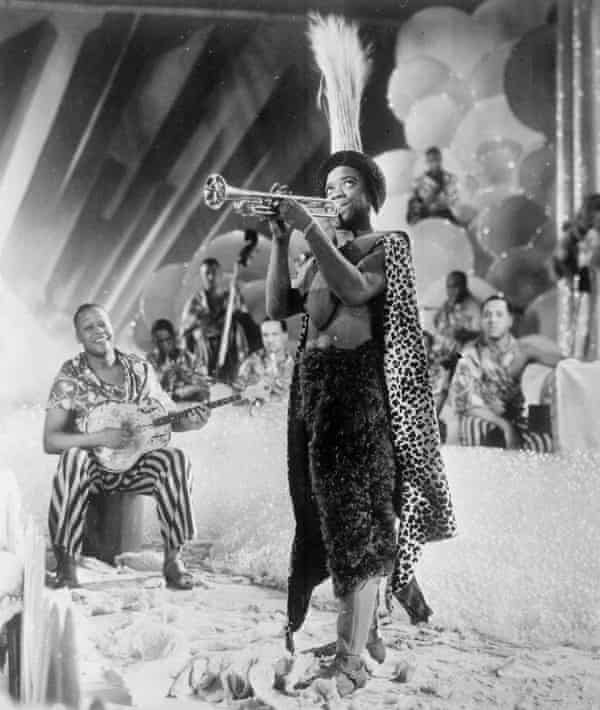
On the set of A Rhapsody in Black and Blue, the earliest surviving footage of Armstrong on film.
On the set of A Rhapsody in Black and Blue, the earliest surviving footage of Armstrong on film. Photograph: Courtesy of the Louis Armstrong House Museum

African Americans found Armstrong more troubling still. The handkerchief-holding persona – cheerful, fond of silly jokes – he’d perfected had echoes of an “Uncle Tom”, a black person who happily does the bidding of a white master.

Bob O’Meally, the head of jazz studies at Columbia University in New York, remains divided. While lauding Armstrong as “one of the greatest people of the 20th century”, he was “offended by his presentations … At the time of the rise of Malcolm X, the authority of Martin Luther King, examples in the popular media like Muhammad Ali and others, there was Armstrong – a kind of throwback from another era, with this borderline minstrelsy role that he played. I cringed as a black American.”

Armstrong’s reputation has improved since, but there’s still much room to recover – and not least in elite circles. Riccardi, a director of research collections at the Louis Armstrong House Museum, recalls that his master’s at Rutgers University in jazz history devoted just two hours to Armstrong in the whole programme. “I go into universities now, and everybody knows every Charlie Parker solo in every key. I say, ‘OK, how many of you have ever checked out Louis Armstrong?’ Blank faces.”

Riccardi’s book spans 1929 to 1947, when Armstrong became the world’s biggest pop star. But going against the usual complaints of critics – who portray the period in almost-Faustian terms – Riccardi sees Armstrong’s escape from jazz royalty as the man’s true making.

For one, crossing over (or “selling out”) as an African American in the 1930s was hardly a ticket to gold and glamour. Just as he got started, Armstrong was jailed and kicked out of California for smoking cannabis; he was later chased from Chicago by gun-toting gangsters and forced to travel with permanent armed protection. On tour in the deep south, Armstrong was turned away constantly from lodgings, struggled getting gigs from racist promoters and was harassed by police. He was sent to jail again while on a pit stop in Memphis, after onlookers grew suspicious about the band’s nice suits, “fancy-looking cigarette holders”, and that the manager’s white wife was sitting on the bus.

His times in Europe were no less challenging. On his first night in London in 1932, Armstrong couldn’t get to bed until 5am because hotels wouldn’t admit black guests. Reviewers wrote of “rhythmical jungle noises”, his “hippopotamus physiognomy”, “gravelly gorilla roar”, and “wild Negro African ancestor’s primitive cries”.

Yet as Riccardi emphasises, meeting culture in the middle meant Armstrong could change things from within. The list of firsts he oversaw is staggering. Knockin’ a Jug, which featured black and white musicians, was one of the US’s first integrated recordings. That same year, he cut the first integrated vocal duet, Rockin’ Chair, with white singer Hoagy Carmichael. Black and Blue, a 1929 B-side on Okeh Records’ “popular music” listings (a label that had previously marketed him for “race records”), has been called American music’s first bona fide protest song against racial inequality.

Lobby card for the now-lost movie Ex-Flame filmed in California in 1930, and featuring Armstrong alongside trombonist Lawrence Brown, pianist Henry Prince, saxophonist Les Hite and 22-year-old drummer Lionel Hampton. Photograph: The Jack Bradley Collection, Louis Armstrong House Museum

On tour in New Orleans, his home town, Armstrong handed out cash in the street, bought a radio set for the orphanage where he grew up, and was the first African American to do his own announcing on city radio. In a first for black musicians, he published an autobiography, Swing That Music, in 1936. The following year, he was the first African American to host a national radio show, and get featured billing in a Hollywood film. For O’Meally, the Columbia jazzer who grew up sceptical, Armstrong’s importance for the cause of racial equality is simply “incalculable.”

At the same time, working the culture from within could raise difficult questions. His stage persona – later problematised by African Americans in the 1950s and 1960s – seemed to fit the cloying stereotypes manufactured by a cynical white media. “He made a lot of black people uncomfortable”, the African American critic Gerald Early said, and Miles Davis, still fond of Armstrong, resented his penchant for “clowning”.

His film appearances in the 1930s posed a particular challenge. In Pennies from Heaven, a launchpad for Armstrong’s multimedia success, he played a mentally challenged farmer that couldn’t count. He was draped in a Tarzan cape in a movie soon after, and was even directly named Uncle Tom in another.

Riccardi offers a subtler take. The tide had certainly turned against him by the 1960s, he concedes, but African Americans were once overwhelmingly supportive of Armstrong. “The black press, they constantly praised his personality” while he rose to fame, he says. “They love the showmanship. They love everything. And I think that’s what always rankled Armstrong [with the Uncle Tom allegations, because] that persona, the smile, the humour, the jokes, the comedy, all the non-musical aspects of his stage persona, were perfected in front of black audiences.”

“I wouldn’t judge Armstrong”, O’Meally says. “The delicacy of the balancing act meant that at times he did fall, he did falter, and contradicted what Martin Luther King and others were trying to do.”

Testing the demarcation lines of jazz would always touch on race, too. “Jazz is an extension of the black voice, of black style, of moving”, O’Meally says. And even as Armstrong moved away from jazz and apparently pandered to white audiences, O’Meally still detects an immutable black essence in his music: “a sense of an audience around the corner”, one away from the white wings, to whom he was really performing.

How Armstrong affected jazz music itself is equally contestable. Catherine Russell is a jazz singer and the daughter of Luis Russell, who worked as Armstrong’s bandleader, including on Song of the Islands, a 1930 Hawaiian muzak single some considered “the beginning of the end”. Jazz has always been a mixture of “high art” and “folk art”, she says, and Armstrong never affected a particular loyalty to either.

His best work, she says – especially the Hot Five recordings of the 1920s – are hardly classical fineries. Big Butter and Egg Man, Irish Black Bottom, Big Fat Ma and Skinny Pa: the Hot Five were dealing in the everyday crudities of blues, putting New Orleans street humour to song. Things would change in the 1940s. Led by Dizzy Gillespie and Parker in New York, the new bebop sound paid little mind to the demands of easy listening. It was harsher, more cerebral, heavily improvised, and conceived as a direct challenge to what Gillespie termed Armstrong’s “Uncle Tom sound”.

Armstrong saw danger in bebop. Its “weird notes” and “Chinese music” was made only for other musicians, he feared, and the consequences would soon come to bear. You could plausibly trace the bebop germ to the 1960s, when it flowered in the dissonant avant garde of free jazz: a sound so harsh and abrasive, the story goes, that black audiences were driven to more accessible alternatives in other genres. If musicians had kept a closer eye on Armstrong’s open-ended approach, Riccardi asks, one wonders where jazz may have headed, and how popular it’d be today.

From left to right: Dizzy Gillespie, unidentified, Louis Armstrong, Arvell Shaw and Big Sid Catlett at a nightclub in the late 1940s. Photograph: Courtesy of the Louis Armstrong House Museum

Yet mixing genres, as Armstrong did, could dilute jazz’s musical core. Crucially, the closer jazz gets to the pop and institutional mainstream, critic Gary Giddins feared in Visions of Jazz, the more a dependence on “big money”, corporate donations and government grants may gnaw at its inner authenticity: the energy that enabled “its glorious eruptions” last century. But playing the field is often the thing keeping jazz alive, and prompts innovation in its own way: think of Davis’s experiments with funk, the growth of jazz fusion in the 1970s, or how most jazz musicians today make their money from playing in other genres. It was called selling out then; it’s collaboration now.

“I don’t see Armstrong turning against the revolution. He had fomented it in the first place and then stepped aside from it and kept going,” O’Meally says. And no matter how rapacious or all-encroaching the music business gets, nothing can ever kill jazz, he claims. Its musical identity – chordal experimentation, the blues undercurrent, playing with notions of time – remains as influential as ever. Even hip-hop is “one of the extensions of the world of Louis Armstrong”, O’Meally says, pointing to Biggie Smalls’ reputed schooling in jazz.

All in all, maybe Armstrong did “sell out”. But in doing so he secured his place in history. Roy Eldridge, “Hot Lips” Page, Henry “Red” Allen, Rex Stewart: the 20th century had plenty of trumpet gods, but they’re sadly forgotten to most.

Armstrong took a different path. “When the world is ready to define what we mean by modernism, we will realise that the shift away from 19th-century forms of music, vocal and instrumental, was something achieved by African Americans,” O’Meally concludes. “Armstrong led the band.”

•

Comments

Popular Posts

THE DAILY TELEGRAPH & FLEET STREET FINANCIAL DISPATCH LONDON — SEPTEMBER 2025 — SPECIAL ECONOMIC INVESTIGATION THE ARCHITECTURE OF GLOBAL CAPITALISM AND THE MECHANICS OF UNIVERSAL DEMAND An Analytical Examination of the Post-War Industrial Order, the Fallacy of Unfettered Laissez-Faire, Mechanisation, and the State-Guaranteed System of Participatory Remuneration BY OUR SPECIAL ECONOMIC CORRESPONDENT IN FLEET STREET, Warren A. Lyon with Cheuy Leon Stephen Lam Tom. LONDON — In the tenth year following the cessation of European hostilities in 1955, as the Western world navigates the transition from wartime economic controls to the mid-century industrial consensus, thoughtful observers in Fleet Street, Westminster, and the City must confront a fundamental problem of political economy. The modern capitalist apparatus—stretching across the United Kingdom, the Commonwealth, North America, and Western Europe—operates upon a single, immutable law: the imperative equilibrium between Supply and Demand. Yet, despite the vast expansion of mechanized production, factory automation, and electronic computation, our financial architectures continue to suffer from a crippling structural defect: the systemic failure to guarantee requisite consumer purchasing power (ability to pay/ATP) across the whole of the populace. I. THE LESSONS OF THE POST-WAR CONSCIOUSNESS: SUPPLY, DEMAND, AND THE ELECTRIC CIRCUIT To comprehend the crisis of modern industrial organization, one must discard the antiquated Victorian dogma that human existence is defined solely by manual toil. Under the classical doctrine of laissez-faire, labour was treated as an elastic commodity, hired when factories required muscle and cast aside into poverty when machines replaced handiwork. In an age dominated by automatic machinery, conveyor systems, and early electronic computing, such a doctrine is not merely obsolete; it is actively destructive to the civic health of the realm. Consider the macro-economic structure as an electrical power grid carrying a constant current of thirty amperes. Under a rational and balanced order, this current is bifurcated equally along two parallel conductors: fifteen amperes are directed to energise the lamp of Industrial Supply (the manufacturing apparatus, capital investment, and technological innovation), while the remaining fifteen amperes flow uninterrupted to power the lamp of Demand—the Ability to Pay vested within the consumer public. In an unregulated laissez-faire system, however, an artificial blockage is introduced along the conductor powering Consumer Demand. It acts as a deliberate obstruction—resembling a corkscrew jammed into the brass fittings of a ship's engine room. The electrical energy, unable to reach the lamp of Demand, encounters extreme resistance; heat builds rapidly within the circuit, insulation scorches, and the entire socio-economic edifice is threatened with catastrophic conflagration. Energy in an economic system, like energy in physics, is never destroyed; if it is denied its proper outlet in legitimate consumer spending, it manifests as market collapse, civil unrest, shoplifting, and social decay. Click here.

Moneyless-ness due to automation is in reality Wage-lessness. By Chuck Sax Windlass Bank with Real Economist News. The core paradox of technological unemployment and aggregate demand—famously captured in the exchange between union leader Walter Reuther and a Ford executive showing off factory robots: when the executive asked how Reuther planned to collect union dues from the machines, Reuther replied, "How are you going to get them( the machines ) to buy cars?" Saving human labor lowers unit costs and expands margins for an individual firm, but across the macroeconomy, wage labor is or was the primary vehicle for distributing consumer purchasing power. Without wages, high-volume production encounters a wall of missing effective demand if this is not substituted with an unconditional universal non means tested benefit. We will face a crisis without this benefit. Blessed is the nation whose God is the Lord. We feed the multitudes. We provide a fraction of the money we saved on wages to the consumer. We ensure the government inputs this benefit throughout the economy, assisting every citizen and permanent resident who are the consumers. We give some money to industrialists within the lawful remit of relevant government programs. But without money provided to consumers, we get an industrial desert. We are just warriors who do have access to the benefits system and will save our home land by paying the benefits to every citizen. It's the law. We are not just orphans needing to be accepted after messing up some where else in the English world. We see no fatties, no trannies, no beardos, no weirdos, no wimps, no radicals; just warriors; and some with beards. It is just that the English people in the world are the only people who have not taken the same solution to Wage-lessness as the other G7 populations. But we boast about those other populations; especially the Chinese. The solution is a guaranteed unconditional universal income support benefit paid to all on your economy who have the right to work. We take a portion back as the sales tax and we can pursue an elevated sales tax on consumer activity (an automation tax) to ensure there is no anxiety about a universal unconditional income support benefit and its cost feasibility. The benefit solves all homelessness crisis or crises. We will clear encampments with emergency benefits cards so people on there encampments can find hotel or motel shelter. With the good benefit we allow people to self serve in answering their problems or needs. We build condos where most of the units can be used as housing at a special housing rate; if they request this special lease rate and qualify as the unemployed. If it's a housing unit, a yellow circle sticker one inch on diameter is placed on the door. The building manager may enter when you are gone out and steal your bacon since you asked for housing. But otherwise it's a condo building unit. A portion of the money goes to the government on all these units. They financed it. But without the benefits paid to all citizens, the English economies remain Orphan economies; Estranged economies. Click here. I don't care what material wealth you have but whatever you have, you must look good and feel good and don't provoke me however about what you have with a Benz abandoned at my palace gate for five minutes; whatever Bahamian you are and then you come to pick it up to be seen by me. We should have more inclusiveness regardless of race but not anxious inclusiveness. We are just as good as those posh bi lingual Europeans. Are we not just as Posh?; or at least we will be, have to be! We will not be diminished by any further debates on this issue of a non-means tested benefit for our economy. It has to be paid to everyone without conditions and those English people moving over seas will get both the English benefit and any Canadian benefits to which they are entitled. This is a Kingly English proper economy worthy of a true European King; worthy of the King of... Bruges, Zurich or Amstel; not this poor lousy, puny minded man, wicked man game from Sarnia with his ultimately racial agenda with political correctness. We will not only keep in pace with these other Royal economies. We will exceed them into terms of payments completed by sending money every two weeks. The economy must revere the Royal laws and mandate. England is Great, England is big. England is grand and we know we can afford it; the unconditional universal income support benefit for every citizen. Anyone who suggested that we are saving money by cancelling benefits for the government employed or for those with savings of £100,000.00 or more is an enemy of England. He gave the Royal 15 Rolexes and then pretended to be his son but he is not a Mountbatten. If he was, he would get dubbed at Hampstead near the Thistle and they would confirm his title. Clearly he is not since means testing is small, poor thinking. He also keeps saying that he wants to know what the Royal understands about anything; and has tried to make him look like a lousy crumpet man; not the food crumpet man. But these policies are not the Royal policies since they fail to actualise true Celtic Gaelic defensiveness, Celtic pride and self preservation with this means testing as if the Royal would ever be anxious about what you could "have" as a plebe. Why are benefits being cancelled if the recipient woman would drink London Pride in public; in Leeds? But you should have something and without stealing it. My proposal for the economy is £100,000.00 per year in benefits without means testing and 50% sales tax; with a virtual currency card. The economy must reference me and my people and I pretended with the man from John Amos only to see what he would do, what he would say if given the chance to try and defame the UK. He has tried to screw me, drug me and make me his widget. Just give them a gift, take a desk and do what you want or he is a son and knows what to do. The Brandon Residential School in Manitoba will be a travellers hostel. We would like to consider all the English people in the world as a market for English and European goods; especially German vehicles and goods; not just American and Japanese goods. Marks and Spencer products will be a feature item offering in all Loblaws shops; especially wines, beers, can sodas and drinks, cookies, candies, soaps, crackers and canned foods. We believe free trade is the best way to achieve this as we understand that we could have unholy trade tariff wars where we all lose. It is the loss in the extended American market for the sale of one's goods and the loss in product diversity that is most troubling. Losing Canada is not so significant to ask of an American beer producer but it is a loss in sales; an unnecessary loss. As we are selling less, we are hiring less people. President Thump knows but he is being threatened by a Canadian to do everything backwards so that he can feel superior to those who went to school at the University of St. Xavier in Nova Scotia. "I was made to make" is a slogan in a new Ontario government commercial about the building of the Ontario subway line. But what about making the population safe and secure in light of the joblessness that causes Wage-lessness and Money-lessness that leads to food and shelter insecurity. We can solve this with the same fortitude used to build a safe subway track with all the anxiety about ensuring life is safe. As such, we build safe social spaces where everyone has enough benefit money to navigate through urban spaces with sufficient financial resources. The government can bail out corporations and finance home construction, build subways also. It must also bail out, guarantee and ensure it's population is safe when facing all the risk of Wage-lessness. North America is a German Japanese car market but no matter how much we save in human labour, what market for sales of the finished product is there if the population does not have any money due to Wage-lessness to...purchase the car product? Without wages, high-volume production encounters a wall of missing effective demand if this is not substituted with an unconditional universal non means tested benefit. This non means-tested benefit is to maintain the Royal plebes. It's given to everyone regardless of means. It's a benefit for all that are settled in our economy. You are a Royal plebe boy, not a martyr, but you will have your benefits and arrears; now. We are tired of the sense of defeat among us while other populations are thriving in our own spaces; including Reading. The English on the other hand is disappearing as if we have resigned occupation of our spaces to all other cultures. Enjoy the Chinese Buffet there now at £15.00 for two buffet plates. But you will be able to afford it. Buy an MG or a Mini Cooper or the BMW or Benz. Be happy. We have more territory than the Swiss so our economy will be just as big or higher as we get out of misery in means testing the benefits. We will follow the Swiss strategy that solves the Wage-lessness. It's a good, White thing. But we have inclusiveness. I had a black girlfriend once and she made me a box of caramel and all kinds of candies and chocolate that made my coiffure go pow. My white girl made bread with iron, pow coiffure and growth power like what you find in a band-aid; the brand name products have more and the store brand products have a little less; and no Cesium. It just builds up in the atmosphere, the soil and the ground water. Only a big mouse or ground hog that was dying of Cesium (rat poison) and that witnessed the stream in which it was dying just evaporate around him would tell us, if given the chance, (some how) that this was his dying experience with water just as he was putting Cesium in all the food and drinks to see it manifest in a deathly way in the atmosphere so you would be warned in his love for mouse kind. Click here.