JOHN F. KENNEDY ON THE ECONOMY AND TAXES.
JOHN F. KENNEDY ON THE ECONOMY AND TAXES
JFK never forgot that he had been elected in 1960 by one of the smallest popular vote margins in US history. The next presidential election was never far from his mind—and seemed to preoccupy his brother Bobby. When liberal Democrats pressed him to promote progressive social programs, he would often point out that he had not won a mandate and remind them that he first had to be reelected.
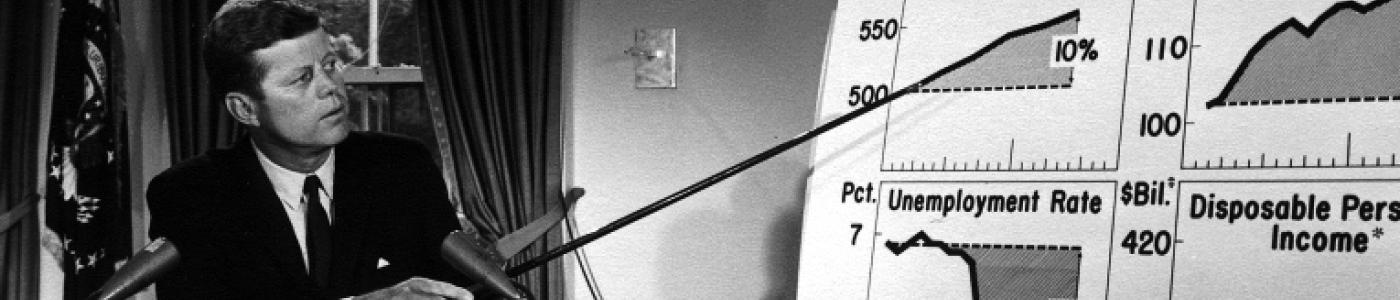
Kennedy had campaigned on the slogan of “getting America moving again” (which the Nixon campaign staff had privately derided as the peristalsis plan). But, recovery from the 1958 recession had been very sluggish and unemployment remained perilously high—6.8% just after he took office. The Council of Economic Advisers urged him to attack unemployment with New Deal style spending but the president was worried that a large deficit ($7 billion) would be politically untenable in 1964. Unemployment did fall modestly, but it remained stagnant at nearly 6% well into 1963. The fact was that the New Frontier had been preoccupied with foreign affairs for three years and once the Limited Nuclear Test Ban Treaty was ratified, JFK realized that it was time to turn to the economy. The 1964 election was barely a year away and likely to be fought against an articulate economic conservative, Senator Barry Goldwater of Arizona.
In addition, JFK’s relationship with the business community had been uneasy from the start. His very public 1961 dispute with US Steel president Roger Blough over an increase in steel prices had reinforced the business community’s suspicions of his motives. Kennedy had won the battle but lost the war—the price increase was canceled but US Steel also announced that its new plants would be built abroad. By 1962, Kennedy’s domestic political fortunes seemed bleak. Unemployment remained high and the stock market had failed to recover after losing a quarter of its value. JFK also ignored the advice of key aides and endorsed efforts to enact medical care for workers over 65 under Social Security and risked his personal prestige by addressing a nationally televised “Medicare” rally in New York. By the time of the May 20 gathering, JFK knew the bill would fail in the Senate after defections by key Democrats, leaving him frustrated, furious, and depressed.
The president finally decided that only a bold domestic program, including tax cuts, would restore his political momentum. Declaring that the absence of recession is not tantamount to economic growth, the president proposed in 1963 to cut income taxes from a range of 20-91% to 14-65% He also proposed a cut in the corporate tax rate from 52% to 47%. Ironically, economic growth expanded in 1963, and Republicans and conservative Democrats in Congress insisted that reducing taxes without corresponding spending cuts was unacceptable. Kennedy disagreed, arguing that “a rising tide lifts all boats” and that strong economic growth would not continue without lower taxes.
The battle over the tax cut and the deficit continued unabated through 1963. The House Ways and Means Committee voted a tax bill out of committee in August and the grateful president reiterated that lowering taxes was the surest path to full employment and lower deficits. Polls showed that over 60% of Americans favored the tax cuts. But, even with the public support of key business leaders like Henry Ford II and David Rockefeller, the Congressional log jam remained unbroken. JFK became increasingly convinced that domestic issues, the economy and civil rights, rather than foreign policy, would prove to be decisive in his 1964 reelection campaign.


Comments
Post a Comment