Merkel: Germany will spend what’s needed to fix flood damage


Merkel: Germany will spend what’s needed to fix flood damage
today
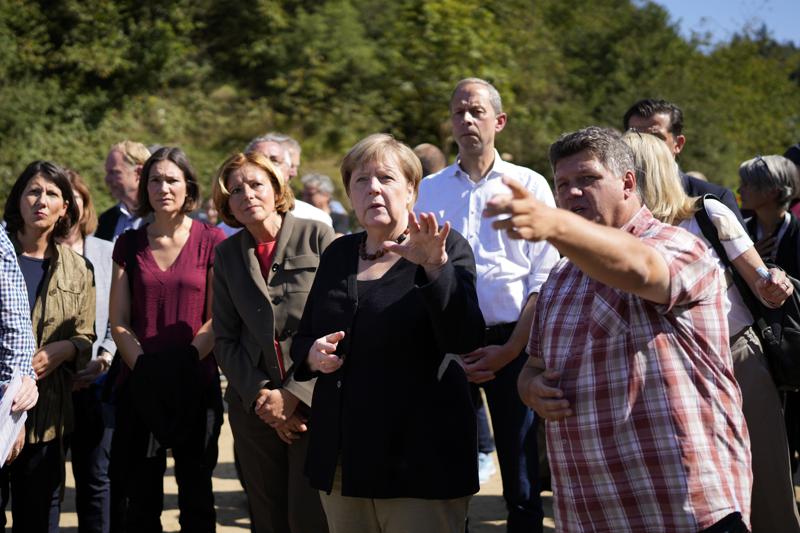
German Chancellor Angela Merkel, center, gestures besides Malu Dreyer, Prime Minister of Rhineland-Palatinate, left, and mayor Ruediger Fuhrmann during their visit to the flood-damaged Altenahr, Germany, Friday, Sept. 3, 2021. After days of extreme downpours causing devastating floods hit the valley of the river Ahr in July. (AP Photo/Markus Schreiber, Pool)
1 of 8
German Chancellor Angela Merkel, center, gestures besides Malu Dreyer, Prime Minister of Rhineland-Palatinate, left, and mayor Ruediger Fuhrmann during their visit to the flood-damaged Altenahr, Germany, Friday, Sept. 3, 2021. After days of extreme downpours causing devastating floods hit the valley of the river Ahr in July. (AP Photo/Markus Schreiber, Pool)

BERLIN (AP) — Chancellor Angela Merkel indicated Friday that German authorities would provide however much money is needed to repair damage caused by devastating July floods, renewing promises for rapid help as she returned to the valley hit worst by the disaster.

More than 180 people died in Germany and hundreds more were injured in the July 14-15 floods, which also claimed lives in neighboring Belgium. Heavy rainfall turned small streams into raging torrents, sweeping away houses, bridges and cars. The narrow Ahr valley, near Bonn in western Germany, suffered the most destruction.

The German government quickly put in place a roughly 400 million-euro ($474 million) package of immediate aid for flood victims. Last month, it agreed to provide 30 billion euros ($36 billion) in longer-term aid to help rebuild the affected regions.

ADVERTISEMENT

Merkel said after visiting the town of Altenahr on Friday that the seven weeks since she first went to survey the flood damage had brought much progress but added, “I have a great deal of respect for what lies ahead of us.”

“We face a very, very long haul,” said the longtime leader, who is not running for reelection in Germany’s federal election this month.

Asked whether 30 billion euros would be enough to cover the cost of rebuilding, Merkel said that if it wasn’t, “any future German government and state government will say, ‘Then we have to do more.’”

“No one needs to be afraid that this will fail because of money,” she said during a news conference.

A German insurance industry group has estimated that the floods likely caused insured damage worth about 7 billion euros ($8.3 billion). It says the total damage will be considerably higher because many buildings weren’t insured for “elementary damage” from events such as floods.

Rhineland-Palatinate’s state governor, Malu Dreyer, said people can start applying for reconstruction aid at the beginning of October.

“I understand the impatience, but we are really working on making it very uncomplicated for people,” she said.

Altenahr Mayor Cornelia Weigand said the rebuilding of the Ahr valley could be tackled as a European “model” for communities located near waterways.

“We must develop concepts for how we can continue to live safely alongside such rivers in times of climate change,” she said.

___

Follow AP’s coverage of climate change issues at https://apnews.com/hub/climate-change

Comments

Popular Posts

THE DAILY TELEGRAPH & FLEET STREET FINANCIAL DISPATCH LONDON — SEPTEMBER 2025 — SPECIAL ECONOMIC INVESTIGATION THE ARCHITECTURE OF GLOBAL CAPITALISM AND THE MECHANICS OF UNIVERSAL DEMAND An Analytical Examination of the Post-War Industrial Order, the Fallacy of Unfettered Laissez-Faire, Mechanisation, and the State-Guaranteed System of Participatory Remuneration BY OUR SPECIAL ECONOMIC CORRESPONDENT IN FLEET STREET, Warren A. Lyon with Cheuy Leon Stephen Lam Tom. LONDON — In the tenth year following the cessation of European hostilities in 1955, as the Western world navigates the transition from wartime economic controls to the mid-century industrial consensus, thoughtful observers in Fleet Street, Westminster, and the City must confront a fundamental problem of political economy. The modern capitalist apparatus—stretching across the United Kingdom, the Commonwealth, North America, and Western Europe—operates upon a single, immutable law: the imperative equilibrium between Supply and Demand. Yet, despite the vast expansion of mechanized production, factory automation, and electronic computation, our financial architectures continue to suffer from a crippling structural defect: the systemic failure to guarantee requisite consumer purchasing power (ability to pay/ATP) across the whole of the populace. I. THE LESSONS OF THE POST-WAR CONSCIOUSNESS: SUPPLY, DEMAND, AND THE ELECTRIC CIRCUIT To comprehend the crisis of modern industrial organization, one must discard the antiquated Victorian dogma that human existence is defined solely by manual toil. Under the classical doctrine of laissez-faire, labour was treated as an elastic commodity, hired when factories required muscle and cast aside into poverty when machines replaced handiwork. In an age dominated by automatic machinery, conveyor systems, and early electronic computing, such a doctrine is not merely obsolete; it is actively destructive to the civic health of the realm. Consider the macro-economic structure as an electrical power grid carrying a constant current of thirty amperes. Under a rational and balanced order, this current is bifurcated equally along two parallel conductors: fifteen amperes are directed to energise the lamp of Industrial Supply (the manufacturing apparatus, capital investment, and technological innovation), while the remaining fifteen amperes flow uninterrupted to power the lamp of Demand—the Ability to Pay vested within the consumer public. In an unregulated laissez-faire system, however, an artificial blockage is introduced along the conductor powering Consumer Demand. It acts as a deliberate obstruction—resembling a corkscrew jammed into the brass fittings of a ship's engine room. The electrical energy, unable to reach the lamp of Demand, encounters extreme resistance; heat builds rapidly within the circuit, insulation scorches, and the entire socio-economic edifice is threatened with catastrophic conflagration. Energy in an economic system, like energy in physics, is never destroyed; if it is denied its proper outlet in legitimate consumer spending, it manifests as market collapse, civil unrest, shoplifting, and social decay. Click here.