EU leader ‘deplores’ Belarus behavior amid migrant standoff today


EU leader ‘deplores’ Belarus behavior amid migrant standoff
today
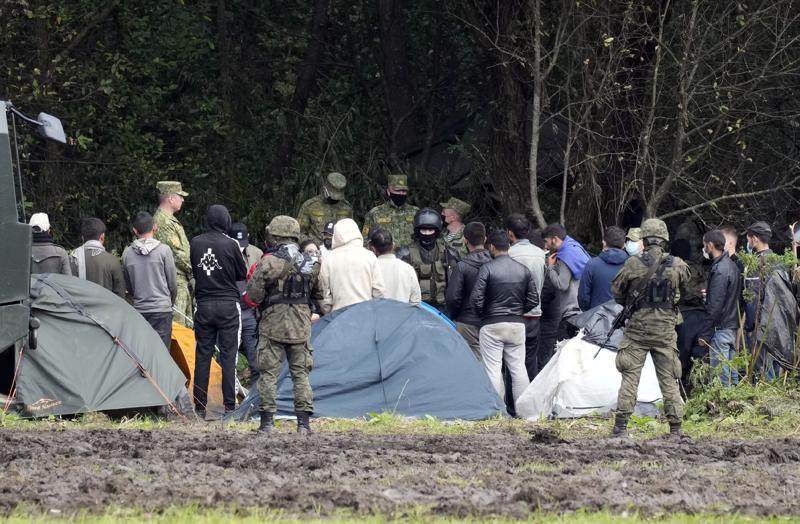
Polish security forces surround migrants stuck along with border with Belarus in Usnarz Gorny, Poland, on Wednesday, Sept. 1, 2021. Poland has been reinforcing its border with Belarus – also part of the EU's eastern border – after thousands of migrants from Iraq, Afghanistan and elsewhere tried to illegally enter the country. The Polish government says it is the target of a "hybrid war" waged by authoritarian Belarus. Human rights activists are concerned about a group caught along the border, trapped between armed guards on each side. (AP Photo/Czarek Sokolowski)

WARSAW, Poland (AP) — A top European Union official condemned Belarus and expressed support for Poland, Lithuania and Latvia on Friday as a state of emergency took effect in areas of eastern Poland following a surge in illegal migration.

EU foreign affairs chief Josep Borrell, speaking at a meeting of EU foreign ministers in Slovenia, said that the EU’s foreign ministers “stand in solidarity with Lithuania, Latvia and Poland and we are ready to take all measures to support them if the situation continues deteriorating.”

He also said that they deplored that Lukashenko’s regime has “cynically” used “migrants and refugees to artificially create pressure on our Eastern borders.”

“We said that when we had some migrant pressure on the Spanish border, we said ‘the Spanish border with Morocco is a European border’. Now it is time to say that the borders of Lithuania and Poland, on the Eastern part of Europe, are also the borders of Europe,” Borrell said.

ADVERTISEMENT

Poland declared the state of emergency after thousands of migrants from Iraq, Afghanistan and elsewhere tried to illegally cross into the country from Belarus in recent weeks.

Poland and the Baltic states argue that Belarus’ President Alexander Lukashenko is waging a “hybrid war” against their countries — EU nations that border Belarus — in revenge for EU sanctions.

All three nations have reinforced their borders and Lithuania and Latvia also declared states of emergency this summer.

Meanwhile, human rights officials have been voicing concern about a group of 32 Afghans stuck for more than three weeks on the Poland-Belarus border.

Polish officials said the state of emergency was needed to halt migration and prevent provocations following a recent protest at the border that involved 13 activists trying to cut a new razor wire barrier. They also cited possible risks linked to Russian military exercises beginning later this month that will also include elements in Belarus.

___

Follow AP’s global migration coverage at https://apnews.com/hub/migration

Comments

Popular Posts

THE DAILY TELEGRAPH & FLEET STREET FINANCIAL DISPATCH LONDON — SEPTEMBER 2025 — SPECIAL ECONOMIC INVESTIGATION THE ARCHITECTURE OF GLOBAL CAPITALISM AND THE MECHANICS OF UNIVERSAL DEMAND An Analytical Examination of the Post-War Industrial Order, the Fallacy of Unfettered Laissez-Faire, Mechanisation, and the State-Guaranteed System of Participatory Remuneration BY OUR SPECIAL ECONOMIC CORRESPONDENT IN FLEET STREET, Warren A. Lyon with Cheuy Leon Stephen Lam Tom. LONDON — In the tenth year following the cessation of European hostilities in 1955, as the Western world navigates the transition from wartime economic controls to the mid-century industrial consensus, thoughtful observers in Fleet Street, Westminster, and the City must confront a fundamental problem of political economy. The modern capitalist apparatus—stretching across the United Kingdom, the Commonwealth, North America, and Western Europe—operates upon a single, immutable law: the imperative equilibrium between Supply and Demand. Yet, despite the vast expansion of mechanized production, factory automation, and electronic computation, our financial architectures continue to suffer from a crippling structural defect: the systemic failure to guarantee requisite consumer purchasing power (ability to pay/ATP) across the whole of the populace. I. THE LESSONS OF THE POST-WAR CONSCIOUSNESS: SUPPLY, DEMAND, AND THE ELECTRIC CIRCUIT To comprehend the crisis of modern industrial organization, one must discard the antiquated Victorian dogma that human existence is defined solely by manual toil. Under the classical doctrine of laissez-faire, labour was treated as an elastic commodity, hired when factories required muscle and cast aside into poverty when machines replaced handiwork. In an age dominated by automatic machinery, conveyor systems, and early electronic computing, such a doctrine is not merely obsolete; it is actively destructive to the civic health of the realm. Consider the macro-economic structure as an electrical power grid carrying a constant current of thirty amperes. Under a rational and balanced order, this current is bifurcated equally along two parallel conductors: fifteen amperes are directed to energise the lamp of Industrial Supply (the manufacturing apparatus, capital investment, and technological innovation), while the remaining fifteen amperes flow uninterrupted to power the lamp of Demand—the Ability to Pay vested within the consumer public. In an unregulated laissez-faire system, however, an artificial blockage is introduced along the conductor powering Consumer Demand. It acts as a deliberate obstruction—resembling a corkscrew jammed into the brass fittings of a ship's engine room. The electrical energy, unable to reach the lamp of Demand, encounters extreme resistance; heat builds rapidly within the circuit, insulation scorches, and the entire socio-economic edifice is threatened with catastrophic conflagration. Energy in an economic system, like energy in physics, is never destroyed; if it is denied its proper outlet in legitimate consumer spending, it manifests as market collapse, civil unrest, shoplifting, and social decay. Click here.