Trump impeachment trial confronts memories of Capitol siege By LISA MASCARO 35 minutes ago. Click here.
Trump impeachment trial confronts memories of Capitol siege
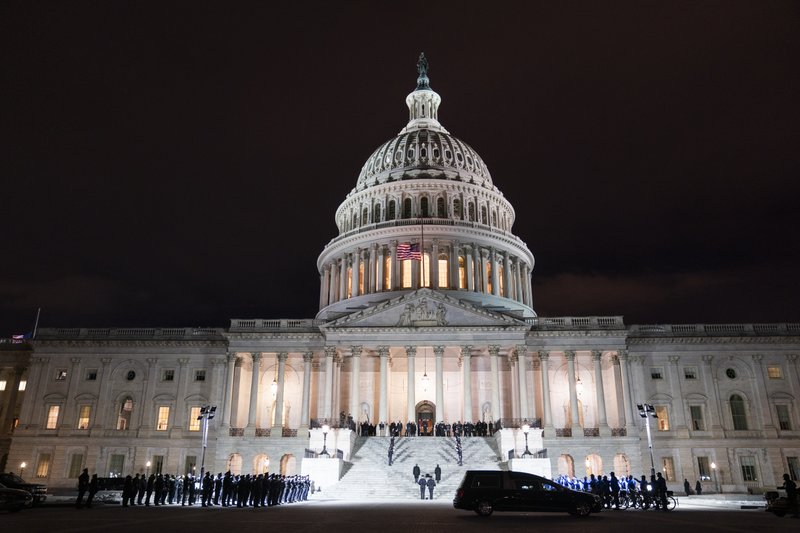
WASHINGTON (AP) — The impeachment trial of Donald Trump is more than an effort to convict the former president of inciting an insurrection. It’s a chance for a public accounting and remembrance of the worst attack on the U.S. Capitol in 200 years.
In the month since the Jan. 6 siege by a pro-Trump mob, encouraged by his call to “fight like hell” to overturn the election, defenders of the former president say it’s time to move on.
Trump is long gone, ensconced at his Mar-a-Lago club, and Democrat Joe Biden is the new president in the White House. With the trial set to begin Tuesday, and a supermajority of senators unlikely to convict him on the single charge, the question arises: Why bother?
Yet for many lawmakers who were witnesses, onlookers and survivors of that bloody day, it’s not over.
One by one, lawmakers have begun sharing personal accounts of their experiences of that harrowing afternoon. Some were in the Capitol fleeing for safety, while others watched in disbelief from adjacent offices. They tell of hiding behind doors, arming themselves with office supplies and fearing for their lives as the rioters stalked the halls, pursued political leaders and trashed the domed icon of democracy.
“I never imagined what was coming,” said Rep. Mark Takano, D-Calif., recounted in a speech on the House floor.
Memory is a powerful tool, and their remembrances, alongside the impeachment proceedings, will preserve a public record of the attack for the Congressional Record. Five people died and more than 100 people have been arrested in a nationwide FBI roundup of alleged ringleaders and participants, a dragnet unlike many in recent times. While that is sufficient for some, assured the perpetrators will be brought to justice, others say the trial will force Congress, and the country, to consider accountability.
Todd Shaw, an associate professor at University of South Carolina, said the founders envisioned a check on the presidency and the trial provides a moment that will demarcate whether American democracy makes a course correction and says “things have gone too far” — or not, he said.
“We’re in a period where a lot of Americans are very aware of that question,” he said.
Defenders of the former president are casting doubt over the legality of the impeachment trial, the rationale for punishing an elected official no longer in office and the political fallout of preventing him from being elected again.
Even Republican critics of Trump, who watched in horror as he encouraged a rally mob outside the White House to make its way to the Capitol, have cooled their outrage with the passage of time and as the reality of Trump’s enduring hold on the party takes shape.
Sen. Ted Cruz, R-Texas, who was among those leading Trump’s charge to challenge Biden’s election, mocked the Senate impeachment case as a “show trial” and waste of time. “It’s time to move on,” he said.
But Sen. Richard Blumenthal, D-Conn., a former prosecutor, said a trial can have a lasting effect of informing the public, regardless of the verdict or outcome.
“A public trial serves a vital purpose,” he said. “What Donald Trump mobilized and emboldened and incited is an expression of domestic terrorism that the public needs to see and understand.”
Several lawmakers stood before the House late Thursday and shared their remembrances: seeing the crowds gather outside the Capitol grounds and hearing the taunts, screams and glass breaking down the halls.
And then “the feeling,” as Rep. Dean Phillips, D-Minn., put it, “of being trapped.”
The House and Senate had been tallying the Electoral College vote certifying Biden’s election victory when Trump, who had refused to concede, his supporters to head to the Capitol.
Phillips said that, as he heard the screams inside the building, he realized a pencil was about all he had for defense. He thought about moving over to the Republican side of the House chamber “so we could blend in.” He and others believed the rioters would “spare us if they simply mistook us for Republicans.”
Then, he said, he realized something — for his colleagues who are not white like he is, “blending in was not an option.”
Rep. Alexandria Ocasio-Cortez, D-N.Y., said the thousands of personal stories from that day, one “just as valid and important as the other,” need to be told at a time when some are trying to minimize what happened. She herself faced detractors who criticized her account as exaggerated.
House Speaker Nancy Pelosi has asked lawmakers to consider compiling their experiences in essays.
Pelosi led Democrats in impeaching Trump, the only president twice impeached, and the first in history to face trial after leaving office.
“Why bother? Why bother?” Pelosi asked. “Ask our founders why bother. Ask those who wrote the Constitution. Ask Abraham Lincoln.”
Pelosi said the House impeachment managers will make their case and “we’ll see if it’s going to be a Senate of courage or cowardice.”
Walking into the Capitol, it’s a changed place. Outside, razor wire tops tall fences surrounding an extended perimeter, even blocking off the nation’s bookshelves at the Library of Congress.
Inside, National Guards troops armed with long rifles patrol the marbled halls day and night, some stopping to snap photos of the ornate statues and symbols of the nation’s history.
While the building hums with familiar sights and sounds, the coffee brewing in the basement cafeteria, there is also a new normal. Broken glass remains on some windows, which some want preserved as a reminder. Posters and handwritten notes thanking Capitol Police officers adorn a basement tunnel.
Rep. Adriano Espaillat, D-N.Y., said in a speech that the attack against the Capitol was an attack on the constituents the lawmakers represent.
“We are their voices here,” he said. “We must not sweep this under the rug.”
___
Associated Press writer Mary Clare Jalonick in Washington contributed to this report.



- Get link
- X
- Other Apps


Comments
Post a Comment